i Short answer
Nothing happens until SARS matches your file against the data it now receives, and then a great deal happens at once. SARS has treated crypto as a taxable intangible asset since 2018, has been sending crypto questionnaires since 2021, and from September 2026 receives every licensed South African exchange's client transactions under the Crypto-Asset Reporting Framework. An undeclared gain attracts the tax itself, interest from the original due date, and an understatement penalty of between 10% and 200% of the shortfall depending on how SARS classifies your behaviour. The Voluntary Disclosure Programme can remove the understatement penalty entirely and avoid prosecution, but only if you apply before SARS notifies you of an audit, and it never waives the tax or the interest.
📋 ON THIS PAGE
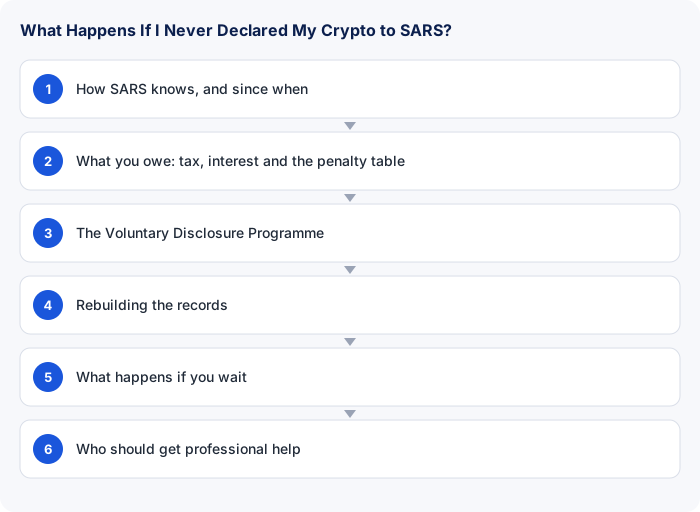
1. How SARS knows, and since when
The belief that crypto is invisible to SARS was already wrong in 2021, when SARS added crypto questions to the income tax return and started sending letters to taxpayers it had identified through exchange data requests. South African exchanges have always been able to respond to a SARS request under the Tax Administration Act, and several confirmed publicly that they did. What changed in 2026 is that the reporting became automatic: under CARF, licensed providers report every client's transactions to SARS from September 2026, and from September 2027 SARS exchanges that information with other countries' tax authorities, which closes the offshore exchange route as well.
SARS also sees the rand. Every deposit to and withdrawal from a crypto exchange runs through a South African bank account, and bank data has been matched against returns for years. A taxpayer with R400,000 of exchange withdrawals and no crypto disclosure on the ITR12 is a straightforward query to generate.
2. What you owe: tax, interest and the penalty table
The first component is the tax you would have paid. Active trading profits are revenue, taxed at your marginal rate up to 45%; long-term holdings sold at a gain are capital, with 40% of the gain above the R50,000 annual exclusion added to income. The second component is interest at the prescribed rate from the date the tax was originally due, which for a 2021 gain assessed in 2026 is five years of compounding. The third is the understatement penalty under the Tax Administration Act, which is where behaviour matters.
| Behaviour | Standard case | Obstructive or repeat case | Voluntary disclosure after audit notice | Voluntary disclosure before audit notice |
|---|---|---|---|---|
| Substantial understatement | 10% | 20% | 5% | 0% |
| Reasonable care not taken | 25% | 50% | 15% | 0% |
| No reasonable grounds for the position | 50% | 75% | 25% | 0% |
| Impermissible avoidance arrangement | 75% | 100% | 35% | 0% |
| Gross negligence | 100% | 125% | 50% | 5% |
| Intentional tax evasion | 150% | 200% | 75% | 10% |
Not disclosing crypto income at all, after SARS has asked about it on the return since 2021, is hard to argue down to "reasonable care not taken". Most undeclared crypto cases land at 50% or above once SARS raises the assessment, which means an undeclared R100,000 of revenue gains at a 41% marginal rate produces R41,000 of tax, R20,500 or more of penalty, and years of interest.
3. The Voluntary Disclosure Programme
The VDP is a permanent programme under Part B of Chapter 16 of the Tax Administration Act. A taxpayer who discloses a default voluntarily, fully and before SARS has notified them of an audit or investigation receives relief from understatement penalties according to the last column of the table, immunity from criminal prosecution for the disclosed default, and relief from certain administrative non-compliance penalties. The tax is paid in full and interest is not waived, although a payment arrangement can follow.
The conditions are strict. The disclosure must be complete: a VDP covering 2023 that omits 2021 and 2022 is not voluntary for the years left out. It must be made before the audit letter, not after; a crypto questionnaire from SARS is generally treated as the start of an investigation for the account it relates to. And it must involve a default that would attract a penalty, which an honest omission of crypto income does. Applications go through eFiling and SARS issues a VDP agreement before the assessments are raised.
4. Rebuilding the records
The practical obstacle to disclosing is usually not willingness but records: a holder who traded on three exchanges between 2019 and 2024 may not know their own gains. The starting point is the full transaction export from every exchange, which licensed providers must retain for at least five years, plus bank statements showing rand in and out. From that, each disposal needs an acquisition cost and a sale value in rand; SARS accepts a consistent method such as first-in-first-out or specific identification, applied the same way every year.
Swaps between coins, spending crypto, and converting to a stablecoin are all disposals and all need a rand value on the day. For periods where a defunct exchange's data is gone, a reconstruction from blockchain records and bank statements, with the method explained, is better than a guess; SARS applies penalties to behaviour, and a documented good-faith reconstruction is the behaviour that gets the lower row.
Export everything
Every exchange, every year, plus bank statements for deposits and withdrawals. Do this before any account is closed.
Classify each year
Revenue or capital, based on how you actually traded. Frequency, holding period and intention decide it, not what you would prefer.
Compute gains with one method
Rand cost and rand proceeds for every disposal, including swaps and spending, using a consistent matching method.
Apply through the VDP before any audit notice
All years, all accounts. A partial disclosure forfeits the relief for what was left out.
Arrange payment
The tax and interest are due; a deferred payment arrangement is available if you cannot settle at once.
5. What happens if you wait
Waiting has three costs that compound. Interest keeps running on the original tax. The penalty row gets worse, because a taxpayer who ignored the 2021 ITR12 question and the 2026 CARF era has a harder time claiming inadvertence than one who came forward. And the VDP door closes the moment SARS's data match produces a letter, after which the best available outcome is the "after audit notice" column. There is also a criminal dimension: wilful non-submission and evasion are offences under the Tax Administration Act, and SARS has pursued crypto cases to prosecution.
The money that is usually lost by waiting is not the tax, which was always owed, but the penalty and the interest, which were avoidable. A R200,000 undeclared gain disclosed through the VDP costs the tax plus interest; the same gain found by SARS in 2027 can cost the tax plus 50% to 150% of it plus six years of interest.
6. Who should get professional help
A holder with one exchange, a few dozen trades and gains in the tens of thousands of rand can usually do the VDP with a tax practitioner's review of the computation. Three situations justify a specialist from the start: multiple years with revenue-level trading volume, where the classification itself is contestable; offshore exchange accounts or wallets, where exchange control exposure runs alongside the tax; and any case where a SARS letter has already arrived, because the response shapes the penalty row. The ITR12 reporting guide covers the forward-looking part; this is about the years behind you.
★ Why It Matters
South Africans who bought crypto between 2017 and 2021 often did so before anyone told them it was taxable, and many have simply never dealt with it. The arithmetic now runs against waiting: the data SARS receives from September 2026 is automatic, and the one programme that removes the penalty requires you to move first.
Key Takeaways
- SARS has taxed crypto since 2018 and receives automatic exchange data under CARF from September 2026.
- Undeclared gains attract the tax, interest from the original due date, and an understatement penalty of 10% to 200%.
- The Voluntary Disclosure Programme removes the understatement penalty and criminal exposure, but only before an audit notice.
- The VDP never waives the tax or the interest; a payment arrangement can follow.
- Disclosure must be complete across all years and accounts to qualify.
- Full exchange exports and bank statements are the basis for any defensible computation.
✕ Common mistakes
- Assuming a small holding is below SARS's interest. Data matching is automated; size is not the filter.
- Disclosing one year and not the others. Partial disclosure forfeits relief for the omitted years.
- Treating a SARS questionnaire as a routine form. It usually marks the end of the VDP window for that period.
- Declaring everything as capital gains to use the 40% inclusion rate when the trading pattern was clearly revenue.
- Closing accounts to limit what SARS can see. The records survive and the behaviour counts against you.
Frequently asked follow-up questions
Can SARS see crypto I hold in a hardware wallet?
Not directly. It sees the rand you used to buy it, the exchange transfers out under CARF and the Travel Rule, and any later sale that touches a licensed provider. The wallet itself is invisible; the entry and exit points are not.
How far back can SARS go?
Three years from the original assessment in the normal course, but there is no time limit where the understatement was due to fraud, misrepresentation or non-disclosure of material facts. Undeclared crypto income usually meets the non-disclosure test.
Does the VDP cover exchange control contraventions?
No. The tax VDP is a SARS programme. FinSurv has run separate regularisation processes in the past, and advisers often approach both regulators together where offshore crypto is involved.
What if my records from a closed exchange are gone?
Reconstruct from bank statements and blockchain data, document the method, and disclose on that basis. A documented reconstruction attracts a lower penalty row than a guess or an omission.
Is the interest negotiable?
Interest is statutory and is not waived under the VDP. SARS may remit interest in limited circumstances outside the VDP, but a holder who did not declare for years rarely qualifies.
Will I be prosecuted if I come forward?
A successful VDP application includes relief from criminal prosecution for the disclosed default. That protection is one of the main reasons to use the programme rather than simply amending returns.
