i Short answer
South Africa taxes you on the way out. When you cease to be a tax resident, the Income Tax Act deems you to have sold your worldwide assets, crypto included, at market value on the day before you leave and bought them back at that value the next day. The resulting gain is a capital gain in your final resident return, with 40% of it added to income after the R50,000 annual exclusion, or revenue income if you were trading. Immovable property in South Africa and assets of a local business are excluded; crypto is not. Coins left on a South African exchange are still deemed sold, and moving them abroad afterwards is a cross-border transfer under the 2026 capital flow rules. The exit charge is the single largest tax event most crypto-holding emigrants face, and it is payable in the year you leave, not when you eventually sell.
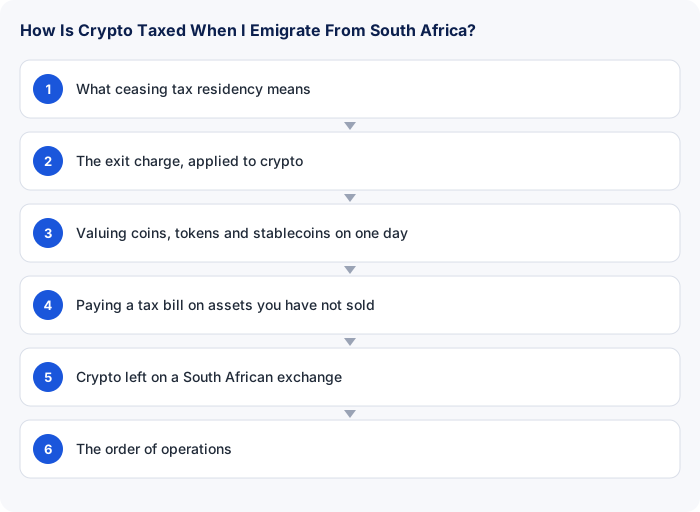
📋 ON THIS PAGE
1. What ceasing tax residency means
You stop being a South African tax resident when you are no longer ordinarily resident here and fail the physical presence test, or when a double tax agreement deems you resident of the other country. Since March 2021 there is no longer a separate "financial emigration" process through the Reserve Bank; the change is a tax one, declared to SARS on your return and supported by evidence such as a foreign residence permit, a home abroad and the end of your South African ties. SARS issues a notice confirming the date of cessation.
That date drives everything in this article. The deemed disposal happens on the day before it. Income earned afterwards is generally outside the South African net, except South African-source income. And the three-year lock on retirement fund withdrawals runs from it. Getting the date wrong, or leaving it ambiguous by keeping a South African home and family while living abroad, is the most common way emigrants end up with two countries claiming the same crypto gain.
2. The exit charge, applied to crypto
Section 9H of the Income Tax Act treats a person who ceases to be resident as having disposed of each asset at market value on the day before cessation and reacquired it at that value. For crypto the mechanics are the same as for offshore shares: you need the rand market value of every coin and token on that day, the base cost you paid for it, and the resulting gain or loss per asset. Gains and losses are aggregated with your other capital gains for the year, the R50,000 annual exclusion applies, and 40% of the net gain is included in taxable income at your marginal rate.
If SARS would have treated your crypto as revenue because you traded actively, the deemed disposal produces revenue income instead, taxed in full at your marginal rate. The classification follows how you held the coins while resident; emigrating does not convert a trader into an investor.
| Item | Rand |
|---|---|
| Market value of all crypto on the day before cessation | R1,800,000 |
| Total base cost (purchases, fees, in rand at the time) | R650,000 |
| Deemed capital gain | R1,150,000 |
| Less annual exclusion | R50,000 |
| Net gain | R1,100,000 |
| Inclusion at 40% | R440,000 |
| Tax at 41% marginal rate | R180,400 |
| Effective rate on the gain | 15.7% |
Illustrative. Other capital gains in the year, the revenue classification, and the taxpayer's actual bracket change the figures. Use the capital gains tax calculator with your own numbers.
3. Valuing coins, tokens and stablecoins on one day
Market value for a liquid coin is the price on a reputable exchange at a consistent time on the day, in rand; using the closing price of the exchange you actually hold on is the easiest to defend. Stablecoins are valued at the rand equivalent of their peg at that day's exchange rate, which means a dollar stablecoin bought at R15 to the dollar and valued at R18 has a gain even though its dollar value never moved. Illiquid tokens, staked positions and tokens in DeFi protocols need a documented valuation basis; an auditor's working or a dated screenshot of the protocol's valuation is the minimum.
Keep the valuation file. The new base cost of every asset after emigration is that day's value, and if you ever become South African resident again, or sell South African-source assets, SARS will ask for it.
4. Paying a tax bill on assets you have not sold
The exit charge is due with the assessment for the year of cessation, whether or not you sold anything. Most emigrants fund it by selling part of the holding, which creates a second, real disposal; if that sale happens after the cessation date it is a disposal by a non-resident of an asset that is not South African-source, so it usually falls outside South African tax, but it may be taxable in the new country. Sequencing the sale before cessation, when the deemed and actual values are close, avoids the mismatch.
SARS can agree deferred payment, but it charges interest, and crypto's volatility means the bill can exceed the asset's value if the market falls between the cessation date and the payment date. Emigrants who leave in a strong market and pay in a weak one have discovered this.
- Real disposal and deemed disposal align
- Rand is in hand to pay the exit charge
- Transfer abroad under the usual allowances
- Gain taxed once, in South Africa
- Exit charge due on unsold coins
- Later sale may be taxed again abroad
- Coins on a SA exchange become a non-resident account
- Transfer out is a cross-border crypto flow under the 2026 rules
5. Crypto left on a South African exchange
Emigrating does not require closing your Luno, VALR or other local account, but it changes its status. The exchange must re-document you as a non-resident under FICA, some restrict services to non-residents, and any transfer of the coins to a foreign platform or your own wallet is a cross-border movement that, under the 2026 capital flow drafts, the exchange reports. Non-residents' assets are not subject to the resident allowances, but the exchange will want your SARS non-residency confirmation before treating transfers that way.
From a tax point of view, selling the coins on the South African exchange after cessation is a disposal by a non-resident; the gain is not South African-source and is generally not taxed here, but the new country of residence will tax it under its own rules, using whatever base cost its law allows. Several common destinations, including the United Kingdom and Australia, have their own arrival rules for assets held on entry; the two systems do not always line up and the gap is where double taxation happens.
6. The order of operations
Fix the cessation date
Decide it with evidence: departure, foreign residence permit, end of South African home and employment. Everything else keys off it.
Reconstruct base costs now
Every purchase, swap and fee in rand at the time. This is the figure that reduces the exit charge and it is hardest to assemble from abroad.
Decide what to sell before the date
Enough to pay the charge, and anything whose double-taxation risk abroad is high.
Value everything on the day before
Consistent source, consistent time, in rand, saved as a dated file.
File the final resident return and confirm non-residency
Declare the cessation, the deemed disposal and pay or arrange payment. Then move the coins, with the exchange reporting the transfer.
The general treatment of crypto gains and the exchange control allowances for residents are covered separately; this article is about the one day they collide.
★ Why It Matters
For most emigrants the exit charge on a house or a pension is manageable because the asset is illiquid and the rules are familiar. Crypto is different: it is liquid, volatile, held across platforms, and valued in a currency that is itself moving. Emigrants who have not planned for the deemed disposal often discover it from a SARS assessment after they have already left, with the coins in a jurisdiction that now also wants its share.
Key Takeaways
- Ceasing South African tax residency triggers a deemed disposal of your worldwide assets, including crypto, at market value on the day before.
- The gain is capital or revenue depending on how you held the coins while resident, with 40% inclusion for capital gains after the R50,000 exclusion.
- Stablecoins and tokens are valued in rand, so currency movements create gains even where dollar values are flat.
- The charge is payable in the year of cessation whether or not you sell; selling before the date aligns the real and deemed disposals.
- Coins left on a South African exchange become a non-resident holding; moving them abroad is a reportable cross-border transfer.
- Base cost reconstruction before departure is the single biggest lever on the bill.
✕ Common mistakes
- Leaving South Africa without fixing a cessation date, then having SARS and the new country both treat you as resident for the same year.
- Forgetting that stablecoins are deemed sold too, with a rand gain from the exchange rate.
- Paying the exit charge by selling coins after cessation and triggering a second tax event abroad.
- Treating the exit charge as a future event. It is assessed in the year of leaving.
- Moving coins to a foreign exchange before the SARS non-residency confirmation and the exchange control reporting are in place.
Frequently asked follow-up questions
Does the exit charge apply if I keep my South African citizenship?
Yes. The trigger is tax residency, not citizenship. A citizen living and working abroad who ceases to be ordinarily resident and fails the physical presence test is a non-resident for tax.
Is there any crypto the exit charge does not reach?
The exclusions are immovable property in South Africa and assets attributable to a South African permanent establishment. Crypto held personally does not qualify for either.
What if the market crashes after I am deemed to have sold?
The deemed gain stands at the value on the day before cessation. A later fall is a loss for the new country of residence, not a reduction of the South African charge. This is the strongest argument for selling enough before the date to cover the bill.
Can I offset crypto losses against the exit gain?
Yes. The deemed disposal covers every asset, so coins standing at a loss on the day reduce the aggregate capital gain, subject to the normal ring-fencing of losses on certain personal-use assets, which crypto is not.
Do I need to close my South African exchange account?
No, but the exchange will re-document you as a non-resident and may limit services. Any transfer of coins abroad afterwards is reported under the Travel Rule, CARF and the capital flow rules.
What about staked coins or coins locked in DeFi?
They are still your assets and are deemed sold at market value. A documented valuation basis for illiquid or locked positions is essential; the gain is on the value, not on whether you could have sold that day.
