i Short answer
Legally, your crypto passes through your deceased estate like a share portfolio: the executor must find it, value it at the date of death, pay the capital gains tax that death triggers and any estate duty, and transfer what is left to your heirs under your will or the intestate succession rules. Practically, it is the one asset that can vanish on the way, because an executor who cannot locate the exchange account or the private keys cannot do any of that. A licensed South African exchange has a deceased-estate process and will release coins to the executor against a letter of executorship; coins in a self-hosted wallet are only ever as recoverable as the access information you left behind. The will should name the asset and where it is held, and a separate, secure document should carry the access details. Writing the seed phrase into the will itself is the mistake, because a will becomes a public document at the Master's office.
📋 ON THIS PAGE
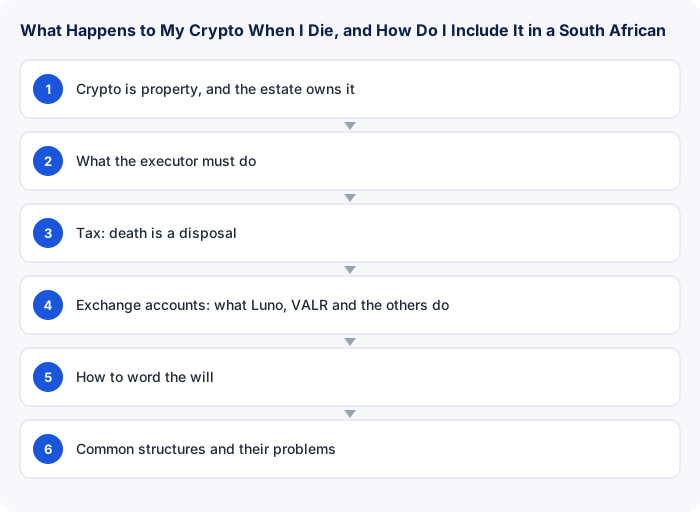
1. Crypto is property, and the estate owns it
South African law treats a crypto asset as an intangible asset forming part of your estate at death, the same as a unit trust or a bank balance. The Administration of Estates Act puts the estate under an executor appointed by the Master of the High Court, who must collect the assets, pay the debts and taxes, and distribute the rest. The executor's authority over an exchange account comes from the letters of executorship, which a licensed exchange will recognise; their authority over a hardware wallet comes from possession of the keys, which no document can grant.
If you die without a will, the Intestate Succession Act decides who inherits, and crypto is divided like everything else. If you have a will but it does not mention crypto, the asset falls into the residue and passes to whoever takes that. Either way, the executor cannot distribute what they do not know exists. Surveys of deceased estates suggest a meaningful share of crypto is simply never found, which is a loss to heirs that no later legal step reverses.
2. What the executor must do
Identify the holdings
Exchange accounts, wallets, staked positions, tokens in DeFi protocols. The inventory for the Master must list them with values at the date of death.
Secure access
Letters of executorship to each exchange; keys or access documents for self-hosted wallets; two-factor devices and email accounts that control recovery.
Value at the date of death
Rand market value from a documented source, for every asset, for both CGT and estate duty.
Deal with SARS
Final return to date of death with the deemed disposal; estate duty return; the estate's own tax number if it earns income or gains after death.
Distribute or sell
Transfer coins to heirs in specie, or sell for rand and distribute cash, as the will directs or the heirs agree.
Executors who are not comfortable with crypto often sell immediately and distribute rand, which is simpler but crystallises any movement since death as a gain or loss in the estate. The will can direct the executor to distribute coins in specie to a named heir, which avoids the second sale and leaves the heir with the date-of-death value as their base cost.
3. Tax: death is a disposal
The Income Tax Act treats death as a disposal of all your assets at market value on the date of death, so unrealised crypto gains are taxed in your final return. The annual exclusion in the year of death is increased to R440,000, and 40% of the net gain above that is included at your marginal rate. Assets left to a surviving spouse roll over without the deemed disposal, with the spouse taking your base cost. The heirs then acquire the coins at the date-of-death market value as their base cost, so a later sale by them is taxed only on the movement after death.
Estate duty is separate. The dutiable estate above the R3.5 million abatement is taxed at 20% up to R30 million and 25% above, with the estate duty reference giving the current figures. Crypto is counted at its rand value at death. An estate with R2 million of Bitcoin, a house and a pension can cross the abatement without the deceased ever having thought of themselves as wealthy.
Worked example: R1,500,000 of Bitcoin, bought for R300,000, in an estate above the abatement
Illustrative. Spousal bequests roll over without the deemed disposal and are deductible for estate duty; other assets and the deceased's bracket change the result.
4. Exchange accounts: what Luno, VALR and the others do
Licensed South African exchanges have deceased-estate procedures. The executor contacts the exchange with the death certificate, letters of executorship and identification; the exchange freezes the account, provides a statement of holdings at the date of death for the inventory, and releases the assets to the executor's instructions, either by selling for rand to the estate's bank account or by transferring coins to a wallet or account the executor nominates. FICA applies to the executor as it would to any client. Timelines vary from weeks to months depending on the exchange and the completeness of the documents.
This is the main reason to hold at least part of a crypto estate on a licensed exchange if your heirs are not technical: the exchange is the counterparty that can be served with a document. A self-hosted wallet has no counterparty.
| Holding | What the executor needs | Risk of loss |
|---|---|---|
| Licensed South African exchange | Death certificate, letters of executorship, ID; the exchange does the rest | Low, if the account is known |
| Foreign exchange | The same documents, often apostilled, under that country's process | Medium; some foreign platforms are slow or uncooperative |
| Hardware or software wallet | The seed phrase or private keys and any passphrase, plus the device PIN | High if access details were not left; total if they were lost |
| Multi-signature wallet | Enough of the keys to meet the threshold | Depends entirely on how the keys were distributed |
| Staked or locked in a protocol | Wallet access plus knowledge of the protocol and unlock periods | High; executors rarely know where to look |
5. How to word the will
The will should do three things and avoid one. It should name the asset class and the places it is held, so the executor knows to look: "my crypto assets, including accounts with licensed South African exchanges and self-custodied wallets listed in my letter of wishes". It should say who gets them and whether in specie or as proceeds. And it should nominate an executor, or an agent to assist the executor, who is capable of handling digital assets, because a family member or a bank-appointed executor may not be. What it must not do is contain the seed phrase, private keys or passwords: a will is lodged with the Master and becomes a public record, and a published seed phrase is an invitation.
The access details go in a separate document, often called a letter of wishes or a digital asset memorandum, stored where the executor can get it: a sealed envelope with your attorney, a safe deposit box, or a split arrangement where no single person holds the whole phrase. Update it when wallets change. The will references the document's existence and location without reproducing its contents.
6. Common structures and their problems
Giving a trusted person the seed phrase now works until the relationship or the person's security fails, and it hands them the asset in law as well as in fact if they choose to take it. A multi-signature wallet split between you, your spouse and your attorney gives redundancy and resists any one party acting alone, at the cost of complexity nobody may understand in ten years. Holding on a licensed exchange relies on the exchange's survival and process, which is the exchange risk covered elsewhere. A trust can hold crypto and avoid the estate entirely, but trusts pay the highest CGT rate in South Africa and need a trustee who can custody keys.
Most estates work best with a mix: the bulk on a licensed exchange with a deceased-estate process, a documented self-custody arrangement for the rest, and a will and letter of wishes that an ordinary executor can follow. The wallet guide explains the custody options themselves.
★ Why It Matters
Every other asset in a South African estate has an institution that can be written to. Crypto in a self-hosted wallet is the only one that disappears if the holder dies with the keys in their head. The law is clear and the tax is routine; the planning is what nobody does, and it is a one-hour job that preserves everything the asset was worth.
Key Takeaways
- Crypto is property in your deceased estate; the executor must find it, value it, pay the tax and distribute it.
- Death is a deemed disposal for CGT with a R440,000 exclusion in the year of death; spousal bequests roll over.
- Crypto counts toward the dutiable estate above the R3.5 million abatement at 20% to 25%.
- Licensed South African exchanges release assets to an executor against letters of executorship; self-hosted wallets require the keys.
- Name the asset and its locations in the will; put access details in a separate secure document; never write the seed phrase into the will.
- Choose an executor or agent who can handle digital assets, and tell them the asset exists.
✕ Common mistakes
- Writing the seed phrase or passwords into the will, which becomes a public document at the Master's office.
- Not mentioning crypto anywhere, so the executor never looks.
- Relying on one person's memory of a hardware wallet PIN.
- Leaving staked or DeFi positions that no executor would know how to find or unlock.
- Assuming the heirs will be able to deal with a foreign exchange's deceased-estate process without apostilled documents and months of delay.
Frequently asked follow-up questions
Can my heirs just log into my exchange account with my password?
They can in practice, but it is unlawful to deal with a deceased person's assets outside the executor's authority, the exchange's terms prohibit it, and any sale is a disposal by the estate that must be declared. Use the deceased-estate process.
Does the Master of the High Court understand crypto?
The Master's office requires an inventory of assets with values; it does not need to understand the technology. The executor provides the exchange statement or a documented valuation of wallet holdings.
What if nobody can find the keys?
The coins remain on the blockchain forever and are lost to the estate. There is no recovery mechanism, which is why the planning matters more than for any other asset.
Is crypto left to my spouse taxed?
Bequests to a surviving spouse roll over for CGT, with the spouse inheriting your base cost, and are deductible for estate duty. Tax arises when the spouse eventually disposes of the coins.
Can I leave crypto to someone outside South Africa?
Yes. The executor transfers the coins or proceeds to the foreign heir, and the transfer is a cross-border movement reported under the capital flow rules by the licensed provider involved. Estate duty and CGT are unaffected by where the heir lives.
Should I put my crypto in a trust instead?
A trust avoids the deceased estate but is taxed at 45% on income and an effective 36% on capital gains unless gains are distributed to beneficiaries, and it needs a trustee able to custody keys. For most individuals a well-drafted will and letter of wishes is simpler and cheaper.
