i Short answer
The United States announced on 2 November 2026 that South Africa will lose its AGOA trade preferences from 1 January 2027, citing barriers to US trade and investment and corruption (The Citizen). AGOA exports were about $1.7 billion in 2025, roughly 10% of South Africa’s exports to the US and about 1% of its exports worldwide, so the direct effect on the economy is small, but exporters of goods such as citrus, wine and car parts lose duty-free access. In the worked example, a $500,000 shipment facing a 3.4% duty costs about R288,000 more.
The currency converter turns a dollar duty into rand at today’s rate.
📋 ON THIS PAGE
- What is AGOA, and what has changed?
- How much of South Africa’s trade is exposed?
- Which exports used AGOA?
- What does losing AGOA cost an exporter? A worked example
- How might the rand and the JSE react?
- What can exporters do?
- How does AGOA eligibility work?
- Can the decision still change before 1 January?
1. What is AGOA, and what has changed?
The African Growth and Opportunity Act, in force since 2000, lets eligible sub-Saharan countries send thousands of products to the US without ordinary import duty. Its recent history has been unsettled:
| When | What happened |
|---|---|
| 30 September 2025 | AGOA lapsed when Congress did not renew it in time |
| February 2026 | Congress revived it retroactively, to 31 December 2026 |
| September 2026 | AGOA itself was extended to 31 December 2028 for all beneficiaries |
| 2 November 2026 | The US announced it will end South Africa’s and Rwanda’s eligibility from 1 January 2027 |
| 1 January 2027 | South African exports lose AGOA treatment unless the decision changes |
The programme continues for other countries; the decision removes South Africa’s eligibility after the annual review (GHY International). The wider tariff picture, including the separate duties on cars and steel, is on the tariffs and trade wars page.
2. How much of South Africa’s trade is exposed?
Less than the headlines suggest. According to the Department of Trade, Industry and Competition, about 89% of South African exports to the US entered under normal World Trade Organization rules in 2025, while AGOA exports were about 10% of exports to the US and about 1% of total exports (The Citizen). Platinum group metals and gold, the largest exports, do not depend on AGOA.
The pain is concentrated in sectors that used the preference: citrus and other fruit, wine, processed food and some vehicle components. Vehicles themselves already face a separate 25% US duty, so AGOA mattered less to car exports in 2026 than it did before. The weight of these sectors on the JSE is small compared with mining and financials, as the JSE sector weights show.
3. Which exports used AGOA?
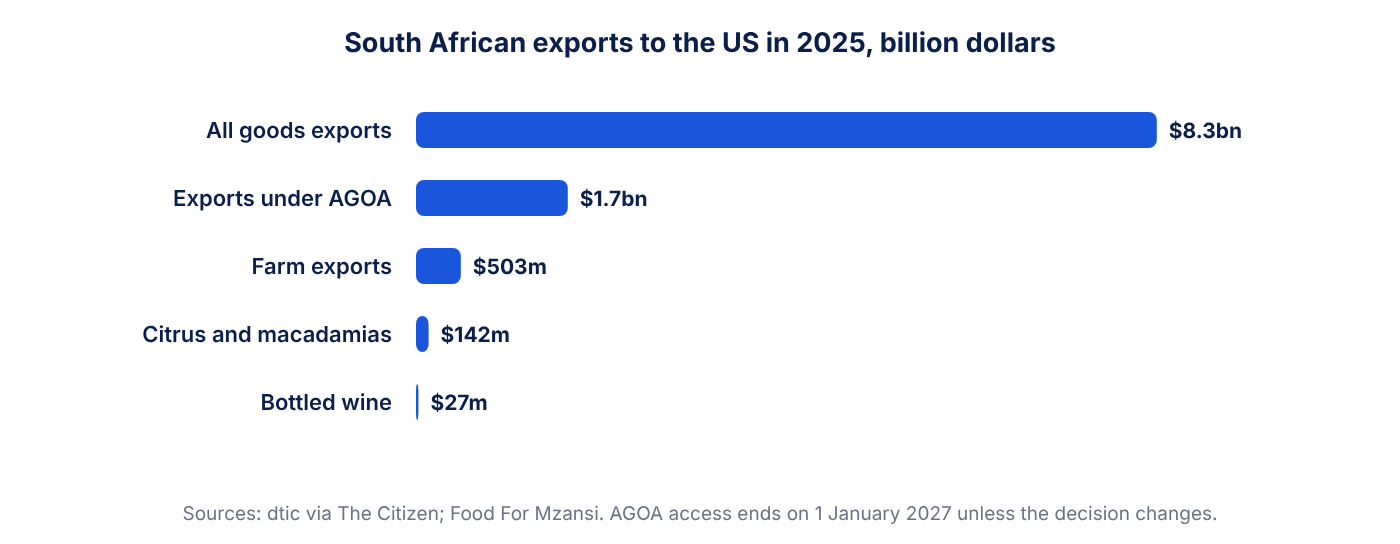
Total South African goods exports to the US were about $8.3 billion in 2025, down from a peak of $13.1 billion in 2021, and agricultural exports to the US were about $503 million (Food For Mzansi). Farm exports are where AGOA mattered most, and they are concentrated in a few products.
| Item | Value | Note |
|---|---|---|
| All goods exports to the US | About $8.3 billion | Down from $13.1 billion in 2021 |
| Exports under AGOA | About $1.7 billion | About 10% of exports to the US |
| Agricultural exports to the US | About $503 million | About 4% of all South African farm exports |
| Oranges, mandarins and macadamias | About $142 million | 28% of farm exports to the US |
| Bottled wine | About $27 million | 5% of farm exports to the US |
The US took about 4% of South Africa’s farm exports, but the products involved, mainly citrus, table grapes, nuts, wine and fruit juices, come from a small number of industries, so the loss falls heavily on those growers (Agbiz).
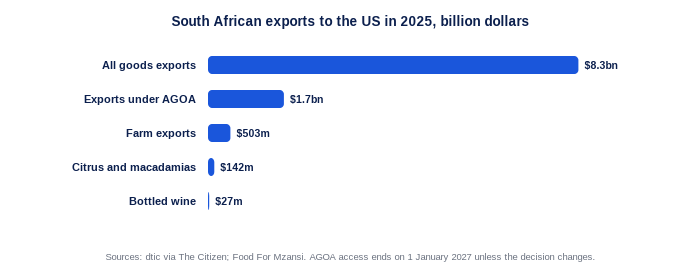
⬇ Download this chart (PNG) · Free to reuse with the credit “Source: TradeAnswers, What Does Losing AGOA Mean for South Africa” (CC BY 4.0).
4. What does losing AGOA cost an exporter? A worked example
Hypothetical figures, using the roughly 3.4% average duty that economists expect South African goods to face once they lose AGOA (Mail & Guardian), and the rand at R16.93 to the dollar on 17 November 2026.
| Step | Calculation | Result |
|---|---|---|
| Shipment value | $500,000 | |
| Ordinary duty under AGOA | 0% | $0 |
| Duty after AGOA | $500,000 × 3.4% | $17,000 |
| In rand | $17,000 × 16.93 | About R288,000 |
The R288,000 has to be absorbed by the exporter, passed on to the US buyer or shared, and it sits on top of any other US tariff already in place. For a business on thin margins, that is the difference between a profitable and a loss-making season, which is why growers’ associations lobbied hardest on the decision.
5. How might the rand and the JSE react?
Economists expect the overall economic effect to be modest because AGOA covers so small a share of total exports (Mail & Guardian). For the rand, the bigger channel is sentiment about relations with Washington, which can add to risk premiums alongside the credit rating and global risk appetite, which pushes money towards safe-haven currencies when it sours. A moving rand also changes the rand value of the duty itself: the weaker the rand, the larger the duty in rand terms.
On the JSE, the most exposed companies are agricultural exporters and food producers; the large miners and banks that dominate the index are barely affected. The rand exchange rate history shows that trade headlines have moved the currency less than global events such as the April 2025 tariff sell-off.
6. What can exporters do?
Three responses are common. Exporters can move volume to other markets: Africa took 53% of South Africa’s farm exports by value in the last quarter of 2025 and the EU 16% (Agbiz). They can renegotiate prices and shipping terms with US buyers so the duty is shared. And because contracts are often priced in dollars, they can manage the currency risk, which matters more when margins shrink; the FX hedging cost calculator compares the cost of a forward with leaving the exposure open.
7. How does AGOA eligibility work?
AGOA is a one-way US preference, not a trade agreement, so the US decides each year which countries qualify. The law sets criteria that include a market-based economy, the rule of law, removing barriers to US trade and investment, efforts against corruption, protection of workers’ rights, and not acting against US national security or foreign policy interests. The US Trade Representative runs an annual review, and the President must give Congress and the country notice before ending eligibility, which is why the 2 November announcement came about 60 days before 1 January (Diplomacy and Law).
Because eligibility is reviewed every year, a country can lose and regain it. That is the basis on which South Africa is still negotiating, and why the decision is described as an intent to terminate rather than a final cut-off.
8. Can the decision still change before 1 January?
Yes, in principle. The President notified Congress of his intent to terminate South Africa’s eligibility, and the termination takes effect on 1 January 2027 unless it is reversed. The US Trade Representative said he remained hopeful that a path forward could be found on wider bilateral concerns (USTR statement), and the Department of Trade, Industry and Competition said South Africa had already offered concessions during talks that began in 2025 (The Citizen).
Signals to watch before the deadline: a US notice confirming or delaying the termination, any announcement of a bilateral trade agreement, and South African support measures for affected exporters. Trade with other partners, including China, is where exporters are expected to look for alternatives.
★ Why It Matters
AGOA is a small share of South Africa’s exports but a large share of some farmers’ and processors’ profits. The decision matters more for specific sectors and for the tone of US relations than for the rand or the JSE as a whole.
✕ Common mistakes
- Treating AGOA as the main tariff issue. The separate US duties on vehicles and steel cost more than losing AGOA.
- Assuming AGOA has ended for everyone. AGOA runs to 2028; only South Africa’s and Rwanda’s eligibility is being ended.
- Expecting a large rand move on the day. The direct trade effect is small; sentiment matters more.
- Ignoring the exchange rate. The rand value of a dollar duty rises when the rand weakens.
Key Takeaways
- South Africa loses AGOA duty-free access from 1 January 2027 unless the US decision changes.
- AGOA exports were about $1.7 billion in 2025, roughly 1% of total exports.
- Citrus, wine, processed food and some car components are the most exposed.
- The economy-wide and rand effects are expected to be modest; sector effects are larger.
Frequently asked follow-up questions
When does South Africa lose AGOA?
From 1 January 2027, after the US announced on 2 November 2026 that it will end South Africa’s eligibility, unless the decision is reversed.
Has AGOA ended?
No. AGOA was extended to 31 December 2028; the decision removes South Africa and Rwanda from it.
How much trade is affected?
About $1.7 billion of exports in 2025, roughly 10% of exports to the US and 1% of exports worldwide.
Which sectors lose most?
Citrus and other fruit, wine, processed food and some vehicle components.
What duty will exports face instead?
The ordinary US duty for each product, which economists put at about 3.4% on average, on top of other US tariffs.
Will the rand fall because of AGOA?
The direct effect is small; the rand reacts more to sentiment about US relations and global risk appetite.
Can the decision be reversed?
Yes, until it takes effect, if the US and South Africa reach an agreement.