i Short answer
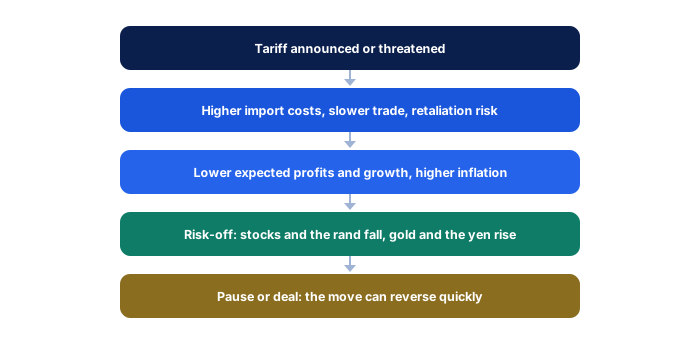
A tariff is a tax on imports, paid by the importing company and usually passed on partly to consumers. Markets react less to the tax itself than to what it signals: slower global trade, higher inflation, lower company profits and the risk of retaliation.
In a trade war, investors usually sell stocks and riskier currencies such as the rand and buy safe havens such as gold, the Japanese yen and the Swiss franc. The size of the move depends on how big the surprise is, which is why markets often rally hard when tariffs are paused or cut.
Key Takeaways
- A tariff raises the price of imported goods; the importer pays it, not the exporting country’s government.
- Markets price the surprise, not the tariff: a bigger-than-expected tariff hits stocks, a pause or cut can trigger a sharp rally.
- Trade wars are usually risk-off events: equities and commodity currencies fall, gold, the yen and the Swiss franc tend to rise.
- The dollar does not always strengthen; in April 2025 it fell as investors questioned US assets.
- For South Africa the main channels are exports to the US and China, commodity prices and global risk appetite, all of which move the rand.
📋 ON THIS PAGE
1. What a tariff is and who actually pays it
A tariff is a tax charged on goods when they are imported. If the United States puts a 12.5% tariff on a product from South Africa, the US company importing it pays 12.5% of the declared value to US customs when the goods arrive. The South African government does not pay it, and neither does the South African exporter directly.
The cost is then shared along the chain. The importer can absorb it and accept a smaller margin, pass it on to customers as higher prices, or push the exporter to cut its price. In practice it is a mix, which is why tariffs tend to raise inflation in the importing country and reduce sales and profits for exporters. A trade war is what happens when the other side retaliates with tariffs of its own and the measures escalate.
| Who | How the tariff reaches them | What markets watch |
|---|---|---|
| Importer | Pays the duty at the border | Profit margins, earnings guidance |
| Consumer in the importing country | Higher shop prices | Inflation data, interest rate expectations |
| Exporter | Lower volumes or price cuts | Export data, share prices of exporters |
| Exporting country’s currency | Fewer dollars earned from exports | Trade balance, current account |
| Global economy | Slower trade and investment | Growth forecasts, commodity prices |
2. How tariffs move currencies
Currencies react through three channels. The first is trade flows: if a country’s exports become more expensive abroad, it earns less foreign currency, which weakens its currency over time. That is the link between tariffs and trade balance data.
The second channel is risk appetite, and it is usually the fastest. When a trade war threatens global growth, investors sell emerging-market and commodity currencies such as the rand, the Australian dollar and the Mexican peso, and buy safe-haven currencies such as the Japanese yen and the Swiss franc.
The third is interest rates. Tariffs push up prices in the country that imposes them, which can make its central bank slower to cut rates. Textbooks say this should strengthen the tariff-imposing currency. Reality is messier: in April 2025 the US dollar fell sharply while US tariffs went up, because investors worried about US growth and the credibility of US policy and moved money out of US assets. The dollar index is the cleanest way to see which story the market is trading.
| Currency type | Examples | Typical first reaction |
|---|---|---|
| Safe havens | JPY, CHF | Strengthen |
| US dollar | USD | Depends: safe-haven buying versus doubts about US assets |
| Commodity currencies | AUD, CAD, NOK | Weaken |
| Emerging markets | ZAR, MXN, BRL | Weaken, often the most |
| Currency of the targeted country | CNY in the US-China dispute | Weaken, sometimes managed by the central bank |
3. How tariffs move stock markets
Stocks are priced on expected future profits. Tariffs raise input costs, reduce export sales and invite retaliation, so analysts cut earnings forecasts and investors demand a bigger discount for uncertainty. Broad indices fall, and volatility rises: the VIX, Wall Street’s fear gauge, tends to jump when tariff headlines hit, as explained in how trading the VIX works.
The damage is uneven. Companies with long global supply chains, such as carmakers, electronics and retailers that import most of their stock, are hit hardest. Exporters to the targeted market lose too. Domestic businesses with local suppliers, and sectors protected by the tariff, can hold up or even gain.
- Domestic utilities and telecoms
- Local producers protected by the tariff
- Gold miners when the gold price rises
- Companies that sell services rather than goods
- Carmakers and component suppliers
- Electronics and hardware with Asian supply chains
- Retailers that import most of their goods
- Exporters of the targeted products, such as citrus and wine
The other pattern is that markets trade the surprise, not the level. Once a tariff is known and in place, prices have usually adjusted. The biggest moves come on the announcement, on escalation, and on any sign of a pause, exemption or deal.
4. Gold, oil and safe havens in a trade war
Gold usually benefits from trade wars. It is bought as protection against slower growth, financial stress and a weaker dollar, and central banks have been large buyers. In early April 2025, as stocks fell, gold kept climbing and reached a record in the following days. For South Africans the effect is doubled when the rand weakens at the same time, which is the link between gold prices and the rand working in reverse.
Oil tends to fall, because slower global trade means less demand for fuel. Industrial metals such as copper and platinum group metals often fall for the same reason, although supply problems or specific exemptions can change that. Government bonds of the large economies usually rally at first as investors look for safety.
5. Case study: the April 2025 tariff shock
On 2 April 2025 the US announced a 10% tariff on almost all imports plus higher “reciprocal” rates for dozens of countries, including 30% for South Africa. It was much bigger than markets expected, and the reaction became one of the sharpest in modern market history.
The biggest gain came on the same week as the biggest losses. Traders who were short into the pause were hit as hard as those who were long into the announcement.
The S&P 500 fell roughly 12% in four trading days and closed on 8 April about 19% below its February record. The VIX jumped from around 21 to an intraday high near 60. Then on 9 April a 90-day pause on most of the new rates sent the index up 9.5% in one session, one of its best days since the Second World War. Emerging-market currencies, the rand included, weakened sharply during the sell-off and recovered part of the move after the pause.
6. Where US tariffs on South Africa stand in 2026
South Africa’s position has changed several times since 2025, so dates matter. The 30% “reciprocal” rate applied from August 2025 under US emergency-powers legislation. In February 2026 the US Supreme Court struck those tariffs down, and a temporary 10% surcharge replaced them from 24 February 2026. That surcharge expired on 24 July 2026, the same day a new 12.5% tariff on most South African goods took effect under Section 301, following a US investigation into forced-labour import rules.
| Measure | Rate | What it covers |
|---|---|---|
| Section 301 tariff (from 24 July 2026) | 12.5% | Most South African goods, with exemptions such as platinum and other precious metals, oranges, fruit juices and nuts |
| Section 232 tariffs | 25% | Vehicles and components, steel and aluminium; these goods are not charged the Section 301 tariff on top |
| AGOA duty-free access | 0% on eligible lines | Removes normal US duties on qualifying goods, but not Section 232 or 301 tariffs; extended to the end of 2028 in September 2026 |
| Previous 30% reciprocal tariff | No longer applies | Struck down in February 2026 |
The US takes a modest share of South Africa’s total exports, so the direct effect on the economy is smaller than the headlines suggest, but it is concentrated in specific sectors: vehicles, some agriculture and manufacturing. The bigger market effect usually comes through global risk appetite, commodity prices and China, which is South Africa’s largest trading partner, as covered in how the trade relationship with China affects the rand.
Check the dates before relying on any figure in this table. Trade policy has moved quickly, and the government has said it will keep negotiating to reduce the Section 301 rate.
7. How traders handle tariff headlines
Tariff news is event risk without a fixed calendar. Some dates are known in advance, such as deadlines for a pause to end or a review to be published, but many announcements arrive on social media or at a press conference with no warning. The practical answer is to manage size and exposure rather than try to predict the headline.
Two tools help. The forex event risk calculator shows what a gap of a given size would do to your account, and the net currency exposure calculator shows how much of your book is really one bet on the dollar or the rand.
- Know the date and time of the deadline in SAST
- Total open exposure to USD, ZAR and global indices
- Rand loss if the market gaps 2% to 3% against you
- Whether any open trades are the same bet in disguise
- Spreads and margin rules at your broker during fast markets
- A plan for both outcomes: escalation and a pause
★ Why It Matters
Tariffs matter to traders because they change expectations about growth, inflation and interest rates all at once. That is why a single announcement can move stocks, currencies, gold and oil together.
The repeated lesson since 2025 is that the reversal can be as violent as the first move. Size for both directions, not just the one you expect.
✕ Common mistakes
- Assuming the dollar always strengthens when the US raises tariffs.
- Treating a tariff headline as the final word when deadlines and exemptions change often.
- Shorting into a sell-off just before a possible pause or deal.
- Ignoring gap risk over weekends and US public holidays.
- Reading the direct export impact on South Africa as the only channel that moves the rand.
See also: How Do Gold Prices Affect the Rand?
See also: What Is a Currency War and Has This Ever Affected the Rand?
Frequently asked follow-up questions
Who pays a tariff, the exporter or the importer?
The importer pays the duty at the border. The cost is then shared: some goes to consumers as higher prices and some to exporters through lower volumes or price cuts.
Why do stock markets fall when tariffs are announced?
Tariffs raise costs, reduce trade and invite retaliation, so expected company profits fall and uncertainty rises. Markets react most to the size of the surprise.
Do tariffs make the dollar stronger or weaker?
It depends. Higher US inflation and safe-haven demand can support the dollar, but in April 2025 the dollar fell because investors worried about US growth and moved money out of US assets.
How do tariffs affect the rand?
Mainly through global risk appetite. In a trade-war sell-off investors sell emerging-market currencies, so the rand usually weakens even when South Africa is not the main target.
Is gold a good hedge against a trade war?
Gold has usually risen during trade-war stress, supported by safe-haven demand and central bank buying. It can still fall sharply when tensions ease, so it is a hedge, not a guarantee.
What tariff does the US charge on South African goods in 2026?
Since 24 July 2026 most South African goods face a 12.5% Section 301 tariff, with exemptions. Vehicles, steel and aluminium face 25% Section 232 tariffs instead. Check the date of any figure, because the rates have changed several times.
Is South Africa still in AGOA?
Yes. AGOA was extended to the end of 2028 in September 2026 and South Africa kept its status, although AGOA does not remove the Section 232 or Section 301 tariffs.
Should I trade tariff headlines?
Only with small size and a plan for both outcomes. Moves are fast, spreads widen and prices can gap through stops, especially when news breaks outside market hours.
Which JSE sectors are most exposed to US tariffs?
Vehicle makers and component suppliers, some agricultural exporters such as non-orange citrus and wine, and manufacturers selling into the US. Precious metals were largely exempted.
