i Short answer
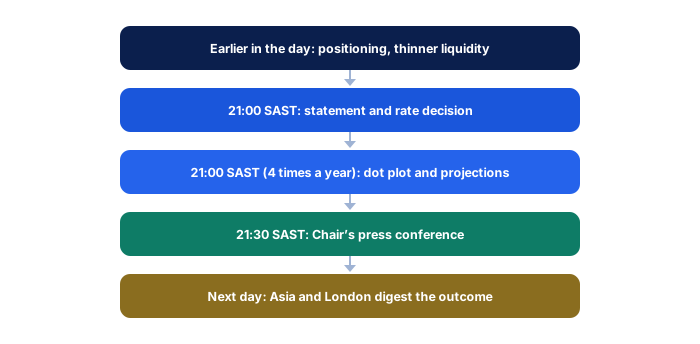
The Federal Open Market Committee (FOMC) is the US Federal Reserve committee that sets the federal funds rate. It meets eight times a year and publishes its decision at 14:00 New York time, which is 20:00 in South Africa while the US is on summer time and 21:00 in the US winter. The Fed Chair’s press conference follows 30 minutes later.
Markets move on the difference between what the Fed does and what was expected. A hawkish surprise usually lifts the dollar and US bond yields and pushes gold, US stock indices and the rand lower; a dovish surprise does the opposite. The press conference often moves prices more than the decision itself.
Key Takeaways
- The FOMC sets the target range for US overnight interest rates, which anchors the dollar and global borrowing costs.
- Decision time in South Africa is 20:00 SAST in the US summer and 21:00 SAST in the US winter, with the press conference 30 minutes later.
- Prices react to the surprise, the statement wording, the dot plot and the Chair’s answers, not just the rate.
- A hawkish Fed usually means a stronger dollar, weaker gold and a weaker rand; a dovish Fed usually means the reverse.
- Spreads widen and prices can jump in seconds, so size down and widen stops or stay flat.
📋 ON THIS PAGE
1. What the FOMC is and what it decides
The Federal Open Market Committee is the part of the US Federal Reserve that sets monetary policy. It has 12 voting members: the seven Fed governors, the president of the New York Fed and four of the other eleven regional Fed presidents, who rotate each year. The Chair leads it; since 2026 that has been Kevin Warsh.
Its main decision is the target range for the federal funds rate, the rate banks charge each other for overnight loans. It also decides on the size of the Fed’s balance sheet. Because the dollar is the world’s main reserve and funding currency, the Fed’s decisions affect borrowing costs and capital flows far beyond the US. That is the same yield-seeking mechanism that links interest rates to currencies, on a global scale.
| Release | When | Why traders watch it |
|---|---|---|
| Policy statement and decision | Every meeting, 14:00 New York time | The rate, the vote split and changes in wording |
| Summary of Economic Projections and dot plot | Four meetings a year: March, June, September, December | Where each member expects rates to go |
| Chair’s press conference | Every meeting, 30 minutes after the statement | Guidance on the next moves |
| Minutes | Three weeks after each meeting | How divided the committee was |
2. Decision day in South African time
The Fed announces at 14:00 Eastern time. South Africa does not change its clocks, but the US does, so the time in SAST moves by an hour twice a year. The FOMC calendar is published a year ahead on the Fed’s website, and an economic calendar set to South African time will show each release automatically.
| Period | Statement | Press conference |
|---|---|---|
| US summer time (second Sunday of March to first Sunday of November) | 20:00 SAST | 20:30 SAST |
| US winter time (rest of the year) | 21:00 SAST | 21:30 SAST |
| Next decision: Wednesday 9 December 2026 | 21:00 SAST | 21:30 SAST |
3. The four things markets read
Most decisions are expected. By decision day, interest rate futures usually show a high probability for one outcome, so the rate itself is often already in the price. What moves markets is anything that changes the expected path of rates.
The first move at the statement is often partly or fully reversed during the press conference, when the Chair’s answers clarify how the committee reads the data.
The vote split matters too. In October 2026 the committee held rates by 10 votes to 2, with two members wanting a further increase, which markets read as a sign that another rise was close. Data released before the meeting shape expectations: inflation figures and the monthly jobs report, covered in what NFP is and how it moves USD/ZAR, are the most important.
4. How the dollar, gold, indices and the rand usually react
A hawkish outcome means higher rates, or higher for longer, than expected. A dovish outcome means lower rates, or sooner cuts, than expected. The table shows the usual first reaction; the size depends on how big the surprise is.
| Market | Hawkish surprise | Dovish surprise |
|---|---|---|
| US dollar and the dollar index | Stronger | Weaker |
| US two-year yield | Up | Down |
| Gold (XAU/USD) | Down | Up |
| US30 and NAS100 | Down | Up |
| USD/ZAR | Up, rand weaker | Down, rand stronger |
| Bitcoin | Usually down | Usually up |
Gold is especially sensitive because it pays no interest: higher US real yields make holding it more expensive. That is why gold traders treat Fed nights as the most important event of the month, as noted in how to trade gold from South Africa.
5. Where the Fed stands in late 2026
After cutting rates in 2024 and 2025, the Fed reversed course in 2026 as inflation stayed above its 2% target. It raised the federal funds rate by a quarter point in September 2026, its first increase since 2023, and held it at 3.75% to 4.00% on 28 October 2026. Two members voted for another increase, and markets have priced in a further rise at the December meeting.
These figures change at every meeting. Check the latest statement on the Federal Reserve’s website before relying on them.
6. The Fed and the SARB
The SARB sets South African rates independently, but it cannot ignore the Fed. If US rates rise and South African rates do not, the gap that attracts foreign money into South African bonds narrows, which tends to weaken the rand and push up imported inflation. That is one reason the SARB raised the repo rate twice in 2026, to 7.25%, as recorded in the SARB repo rate history.
The two meetings rarely fall in the same week, but the order matters. The SARB’s last decision of 2026 is on 19 November, before the Fed meets on 8 and 9 December, so local markets will price the SARB decision partly on what they expect from the Fed. The SARB MPC meeting calendar lists the 2027 dates, and what a SARB rate decision means for traders covers the local side.
7. Trading the Fed: managing the risk
Fed nights produce some of the biggest one-hour moves of the year in gold, US indices and USD/ZAR. Spreads widen just before 20:00 or 21:00 SAST, orders can fill well away from the requested price, and stops can be skipped. Slippage is the main hidden cost.
The forex event risk calculator shows what a typical Fed-night move in a given pair would do to your account at your current size, which is the quickest way to decide whether to stay in a trade.
- Decision and press conference times in SAST
- What the market expects, from futures pricing or the calendar consensus
- Whether this meeting includes the dot plot
- Open positions in USD pairs, gold, US indices and USD/ZAR
- Free margin if price moves 1% to 2% against you
- Whether to stay flat until after the press conference
★ Why It Matters
The Fed sets the price of the world’s main currency, so its decisions reach South African traders through the rand, gold and global stock markets on the same evening.
The useful question on decision day is not what the Fed will do, but what the market already expects. The trade is in the difference.
✕ Common mistakes
- Using the summer decision time in the US winter, or the reverse.
- Treating the headline rate as the whole story and ignoring the dot plot and press conference.
- Holding tight stops through the release and getting filled far away.
- Trading the first spike before the statement has been read.
- Forgetting that JSE shares only react the next morning.
See also: What Happens to Currency Pairs During Major News Events?
See also: How Do I Trade US30 and NAS100 From South Africa?
Frequently asked follow-up questions
What time is the Fed decision in South Africa?
At 20:00 SAST while the US is on summer time (mid-March to early November) and 21:00 SAST in the US winter. The press conference starts 30 minutes later.
How often does the FOMC meet?
Eight times a year, roughly every six weeks. Four of those meetings also publish economic projections and the dot plot.
What is the dot plot?
A chart showing where each FOMC participant expects the federal funds rate to be at the end of the next few years. It is published in March, June, September and December.
Why does gold fall when the Fed is hawkish?
Gold pays no interest, so higher US rates and real yields make holding it less attractive, and a stronger dollar makes it more expensive in other currencies.
How does a Fed decision affect the rand?
A hawkish surprise usually strengthens the dollar and weakens the rand; a dovish surprise usually strengthens the rand. The reaction is often larger than in major pairs because liquidity is thinner in the South African evening.
What is the current Fed interest rate?
The target range was 3.75% to 4.00% after the 28 October 2026 meeting. Check the Federal Reserve’s latest statement, because it can change at each meeting.
When is the next FOMC meeting?
8 and 9 December 2026, with the decision on Wednesday 9 December at 21:00 SAST.
Should beginners trade Fed announcements?
It is safer not to. Spreads widen, slippage is common and the direction can reverse during the press conference. Many experienced traders stay flat until the dust settles.
Does the Fed affect the SARB’s decisions?
Indirectly. A wider gap between US and South African rates affects capital flows and the rand, which feeds into inflation, so the SARB takes the Fed’s path into account.
What is the difference between hawkish and dovish?
Hawkish means leaning towards higher rates to fight inflation; dovish means leaning towards lower rates to support growth and jobs.
