i Short answer
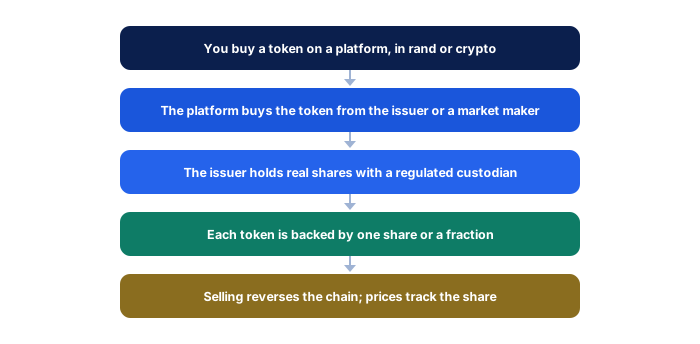
A tokenized stock is a digital token on a blockchain that represents a share in a listed company, such as Apple or Nvidia. Most tokens sold to retail investors today are issued by a third party that buys the real shares, holds them with a custodian and issues tokens backed one-for-one.
You can buy and sell many of these tokens around the clock, including weekends, but the underlying shares still trade only during US market hours. Outside those hours prices are set by the platform and its market makers, so spreads are wider and the price can jump when Wall Street reopens. In South Africa, platforms such as Luno and VALR have offered them since August 2025.
Key Takeaways
- A tokenized stock gives you price exposure to a share through a token, usually backed by real shares held by an issuer.
- There are two models: third-party backed tokens such as xStocks, and exchange-native tokenized shares such as those approved for Nasdaq in 2026.
- Trading 24/7 is possible on many platforms, but out-of-hours prices are not set by the stock exchange.
- Most backed tokens give price exposure, not shareholder rights such as voting.
- Your risks include the issuer, the custodian and the platform, not only the share price.
📋 ON THIS PAGE
1. What a tokenized stock is
A tokenized stock is a share represented as a token on a blockchain. The idea is the same as a Bitcoin ETF in reverse: instead of wrapping a crypto asset in a traditional fund, a traditional asset is wrapped in a crypto token. The token can be held in a crypto wallet, sent between wallets and traded on crypto exchanges.
The spelling depends on where you are: “tokenized” in the US and most of the industry, “tokenised” in South Africa and the UK. Both mean the same product. What matters is the structure behind the token, because two tokens with the same ticker can give you very different rights.
2. The two models: backed tokens and exchange-native shares
Most tokenized stocks that retail investors can buy today are backed tokens. A company such as Backed Finance, the issuer of the xStocks range launched in 2025, buys the real shares, holds them with a custodian, and issues tokens that each represent one share or a fixed fraction. The token tracks the share price, but you are usually a creditor of the issuer, not a registered shareholder.
The second model is exchange-native tokenized shares. In March 2026 the US Securities and Exchange Commission approved a Nasdaq rule change that lets Russell 1000 stocks and major index ETFs trade in tokenized form, alongside a tokenization pilot run by the Depository Trust Company (DTC). These carry the same rights as ordinary shares, trade on the same order book and still settle through the normal US system.
| Feature | Backed tokens (e.g. xStocks) | Exchange-native (Nasdaq and DTC model) |
|---|---|---|
| Who issues the token | A third-party issuer | The market infrastructure, on behalf of the shareholder |
| Shareholder rights | Usually price exposure only | Same rights as the ordinary share |
| Trading hours | Often 24/7 on crypto platforms | Exchange hours, same order book as normal shares |
| Who can buy | Users of platforms that list them, often outside the US | Participants of the US market system |
| Main extra risk | Issuer, custodian and platform | Operational, as a new system |
For a South African retail investor in 2026, “tokenized stocks” almost always means the first model.
3. Can you really trade shares 24/7?
Yes and no. Many platforms let you buy and sell tokenized stocks at any hour, including Saturday and Sunday. But the New York Stock Exchange and Nasdaq are still closed overnight and at weekends, so there is no official price for the underlying share at those times. The quote you see comes from the platform and its market makers, based on related markets, futures and their own risk.
In practice that has three consequences. Spreads, the gap between the buy and sell price, are usually wider outside US hours. The token price can drift away from the last closing price and then snap back when the US market opens. And news that breaks on a weekend, such as earnings surprises or tariff announcements, will be priced first on thin out-of-hours trading.
| Session | US summer time (mid-March to early November) | US winter time |
|---|---|---|
| Regular session | 15:30 to 22:00 | 16:30 to 23:00 |
| Pre-market (typical) | 10:00 to 15:30 | 11:00 to 16:30 |
| After-hours (typical) | 22:00 to 02:00 | 23:00 to 03:00 |
| Weekends | Closed | Closed |
5. How South Africans can buy tokenized stocks
In August 2025 two local crypto platforms, Luno and VALR, added tokenized US shares and ETFs from the xStocks range. Luno launched with more than 60 stocks and ETFs priced in rand and reported a flat 1% trading fee at launch. Both platforms are licensed by the FSCA as crypto asset service providers. Check the current list of stocks, fees and terms on the platform itself, because they change.
Choosing where to buy follows the same rules as choosing any crypto platform: licence, fees, how withdrawals work and who holds the assets, as set out in how to choose a crypto exchange in South Africa. Buying on an offshore exchange instead means sending money abroad, which uses your exchange control allowances.
- Who issues the token and where its prospectus or terms are
- Which custodian holds the underlying shares
- Whether you can redeem for shares or only sell the token
- How dividends are handled: paid out, reinvested or not passed on
- The platform’s FSCA licence and fee per trade
- The spread at the time you plan to trade, inside and outside US hours
6. The risks most buyers miss
The share price is only one of the risks. With a backed token you also rely on the issuer to hold the shares it says it holds, on the custodian to keep them safe, and on the platform to stay solvent and let you withdraw. If a platform fails, your position depends on how your assets were held, which is covered in what happens to your crypto if an exchange collapses.
- Small amounts and fractions of expensive shares
- Buy in rand from an account you already use
- Trade at any hour, including weekends
- No leverage and no overnight financing as standard
- Usually no voting or other shareholder rights
- Issuer, custodian and platform risk on top of market risk
- Wider spreads and price gaps outside US hours
- Rules are still developing in the US, the EU and South Africa
Rules are also moving. The US approved exchange-native tokenized trading in 2026, the EU treats many tokens as financial instruments, and some US platforms do not offer backed tokens to US residents at all. A product available today can change its terms or be withdrawn in a particular country.
7. Tax on tokenized stocks in South Africa
SARS taxes the gain, not the product label. If you buy and hold for the long term as an investment, gains are generally capital gains, and the capital gains tax calculator shows the effect of the annual exclusion and inclusion rate. If you trade frequently to make short-term profits, SARS can treat the profits as income taxed at your marginal rate.
Tokenized stocks are held and traded on crypto platforms, so keep the same records you would for crypto: dates, rand values at each trade, fees and platform statements. The steps in how to report crypto on your SARS return apply. Dividends are taxable too, whether they are paid out or reinvested into the token. Get advice from a registered tax practitioner if your amounts are large, because SARS has not published guidance specific to tokenized shares as at November 2026.
★ Why It Matters
Tokenized stocks make it easy to own a small piece of a US company from a South African crypto account, at any hour. That convenience is real.
What you own is not always the same as a share. Read who stands behind the token before you buy, and treat weekend prices as the platform’s estimate, not the market’s.
✕ Common mistakes
- Assuming a token gives you voting rights or a registered shareholding.
- Buying on a weekend at a wide spread and expecting the Monday open to match.
- Ignoring the issuer and custodian behind the token.
- Forgetting that dividends and gains are taxable in South Africa.
- Using tokenized stocks for long-term investing when a low-cost ETF would do the job more simply.
See also: How Does Bitcoin CFD Trading Differ From Buying Actual Bitcoin?
See also: Can I Hold Crypto in My TFSA or Retirement Annuity in South Africa?
Frequently asked follow-up questions
What is a tokenized stock?
A digital token on a blockchain that represents a share in a listed company. Most retail tokens are backed one-for-one by real shares held by an issuer and a custodian.
Is a tokenized stock the same as owning the share?
Usually not. Backed tokens give price exposure and are a claim on the issuer, without voting rights. Exchange-native tokenized shares approved for Nasdaq in 2026 do carry the same rights as ordinary shares.
Can you trade tokenized stocks 24/7?
On many platforms, yes, including weekends. The underlying US market is still closed outside its hours, so out-of-hours prices come from the platform and its market makers, with wider spreads.
Can South Africans buy tokenized stocks?
Yes. Luno and VALR have offered tokenized US shares and ETFs from the xStocks range since August 2025, priced in rand. Check the current list and fees on each platform.
Are tokenized stocks legal in South Africa?
Crypto assets are regulated financial products in South Africa and platforms need an FSCA licence. Use a licensed platform and check its terms for tokenized shares.
Do tokenized stocks pay dividends?
It depends on the issuer. Some pass dividends on or reinvest them into the token. Check the token’s terms before buying.
How are tokenized stocks taxed in South Africa?
Like other investments: capital gains tax if you hold as an investment, income tax if you trade frequently for profit. Dividends are also taxable. Keep full records of every trade.
What is the difference between tokenized stocks and CFDs?
A CFD is a leveraged contract with your broker with overnight financing. A backed tokenized stock is unleveraged and backed by real shares, but adds issuer and platform risk.
Is it tokenized or tokenised?
Both. “Tokenized” is the US spelling and “tokenised” the South African and UK spelling of the same product.
