i Short answer
The Conduct of Financial Institutions Bill, known as COFI, would put the conduct of every financial institution under one law and one FSCA licence, replacing much of today’s patchwork of sector laws, including FAIS (Horizon Compliance). Cabinet approved it in March and April 2026, notice of its introduction to the National Assembly was gazetted on 17 April 2026, and a transition of about three years is expected once it is passed. For investors, the main change is that treating customers fairly becomes enforceable law rather than a supervisory principle.
📋 ON THIS PAGE
1. What is the COFI Bill?
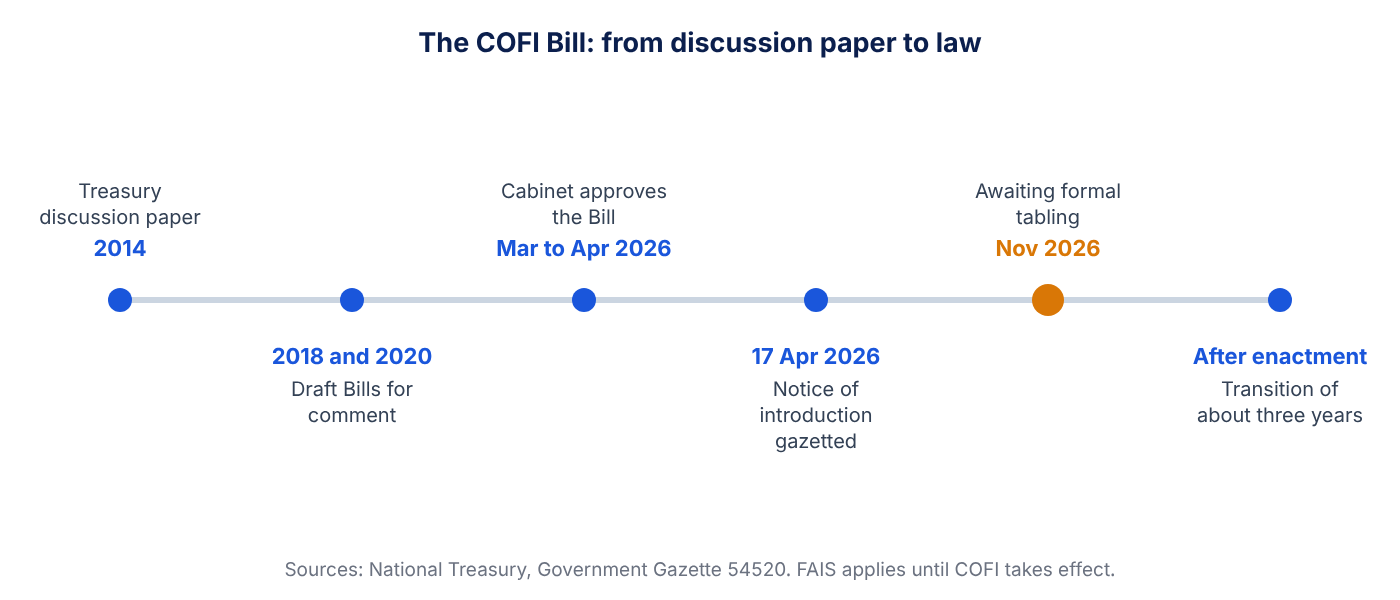
COFI is the second half of the twin peaks reform. The Financial Sector Regulation Act of 2017 created the two regulators; COFI rewrites the conduct rules the FSCA enforces. The work began with a National Treasury discussion paper in 2014, followed by draft Bills in 2018 and 2020 (Cliffe Dekker Hofmeyr).
Instead of separate laws for advisers, insurers, collective investment schemes and others, COFI sets one framework built on principles and customer outcomes. The current laws, and how they fit together, are listed on the South African financial laws page.
2. Where does the Bill stand?
| When | Step |
|---|---|
| 2014 | National Treasury discussion paper on a new conduct framework |
| 2018 and 2020 | Draft Bills published for comment |
| 25 March and 1 April 2026 | Cabinet approved the Bill for submission to Parliament |
| 17 April 2026 | Notice of introduction gazetted (Government Gazette 54520, Notice 7376) |
| October 2026 | Still not formally tabled in Parliament, more than four months after the notice |
| 23 November 2026 | No report of formal tabling found when this page was last checked |
| After it is enacted | A transition of about three years |
The notice was a procedural step; the formal legislative process starts only when the Bill is tabled (Moonstone, October 2026). Until COFI is passed and its transition ends, FAIS and the other current acts still apply, and an adviser’s or broker’s licence is still the FAIS licence shown on the FSCA register (Horizon Compliance). Some law-firm summaries in April and May 2026 described the notice as the Bill’s introduction; legal commentators have since pointed out that it is only the required pre-tabling step (SA Legal Academy, August 2026).
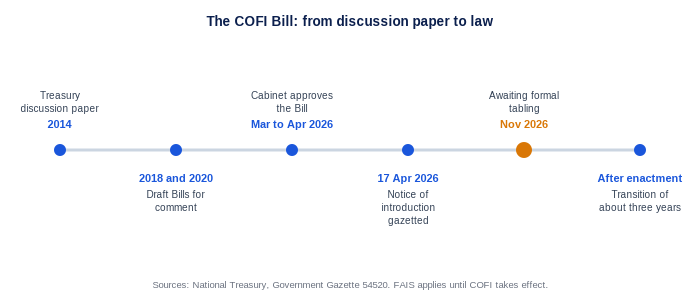
⬇ Download this chart (PNG) · Free to reuse with the credit “Source: TradeAnswers, The COFI Bill Explained” (CC BY 4.0).
3. What will change?
| Area | Today | Under COFI |
|---|---|---|
| Licensing | Separate licences by sector and product category, such as FAIS categories | One FSCA licence with authorisations for each activity |
| Treating customers fairly | A supervisory framework and part of codes of conduct | Enforceable law |
| Rules | Detailed rules in several laws | Principles and outcomes in one law, with conduct standards |
| Product oversight | Uneven across sectors | Obligations across a product’s whole life |
| Complaints and redress | Varies by sector | More focus on post-sale service and complaints handling |
Firms will hold a single licence with authorisations linked to the activity, the product and the type of customer (Werksmans). The FSCA has said existing licence holders will be moved across rather than having to apply again (Moonstone). The current FSP licence categories therefore stay relevant during the transition.
4. What are the six fair-treatment outcomes?
Treating customers fairly is built around six outcomes that the FSCA already expects firms to deliver (Financial Mail). Under COFI they become legal duties rather than supervisory expectations.
| Outcome | What it means for you |
|---|---|
| Fair treatment is part of the firm’s culture | The firm is run with your interests in mind, not only its sales |
| Products are designed for the people they are sold to | A product is aimed at customers it suits |
| Information is clear and timely | You get costs, risks and terms in plain language, before and after you buy |
| Advice is suitable | Any advice takes your circumstances into account |
| Products perform as you were led to expect | Service and results match what was promised |
| No unreasonable barriers after the sale | You can switch, claim or complain without obstacles |
The FSCA has already written these outcomes into rules for some sectors, such as the Conduct Standard for Banks published on 3 July 2020 (Werksmans). COFI applies them across the whole financial sector.
5. What should you check with your provider now?
Nothing has to change on your side yet, but three checks are worth doing whatever happens to the Bill. Confirm that the provider’s FSP number appears on the FSCA register and covers the products it sells you. Ask for its complaints process in writing, including how long it takes to respond. And make sure you have its full costs in rand, including spreads and overnight charges, which the trading cost calculator can total for a typical year.
6. How would a broker’s licence change? A worked example
A hypothetical example of how licensing changes shape, not a ruling on any real firm. A broker today holds a FAIS licence covering advice and intermediary services for derivatives such as CFDs, and acts as the counterparty to its clients’ trades.
| Today | Under COFI | |
|---|---|---|
| Licence | FAIS licence in the relevant product categories | One FSCA licence |
| What the licence lists | Product categories | Activities, such as giving advice, acting as an intermediary and dealing as principal, each linked to products and customer types |
| What the regulator checks | Compliance with the FAIS rules | Evidence that each activity produces fair outcomes for customers |
For a client, the difference shows in what the broker must prove: not only that it followed the rules, but that its products, disclosures and complaints handling treat customers fairly in practice (Masthead).
7. What does COFI mean for investors and traders?
Three things change from a customer’s point of view. Treating customers fairly becomes a legal duty, so unfair outcomes can be acted on directly through the FSCA’s enforcement powers. Disclosure of features, costs and risks becomes a requirement across all financial products, not only those covered by FAIS today. And complaints handling and service after the sale get more attention, alongside the existing ombud schemes.
What does not change yet: until COFI is enacted, your protection rests on the current laws described in what FSCA regulation protects you from, and complaints about advice still go to the provider first and then to the FAIS Ombud.
★ Why It Matters
COFI does not create new protection overnight. It turns principles that good providers already follow into law, and gives the FSCA one licence and one rulebook to hold every financial institution to them.
✕ Common mistakes
- Assuming COFI is already law. It is still before Parliament; FAIS applies until COFI is enacted and its transition ends.
- Thinking every provider must reapply. The FSCA has said existing licence holders will be moved across.
- Expecting licence categories to disappear at once. The current categories remain on the register during the transition.
- Reading TCF as a guarantee of returns. Fair treatment covers how products are designed, sold and serviced, not investment results.
Key Takeaways
- COFI puts all financial conduct under one law and one FSCA licence.
- Cabinet approved it in 2026, and it awaits formal tabling in the National Assembly.
- Treating customers fairly becomes enforceable law.
- FAIS and the current licences apply until COFI is enacted and its transition of about three years ends.
Frequently asked follow-up questions
What does COFI stand for?
The Conduct of Financial Institutions Bill.
Is COFI law yet?
No. Cabinet approved it in March and April 2026 and its introduction was gazetted on 17 April 2026, but by October 2026 it had still not been formally tabled in Parliament.
Does COFI replace FAIS?
Yes, over time. FAIS is expected to be repealed, with many of its principles carried into COFI.
Will my financial adviser need a new licence?
Existing licence holders are expected to be moved to COFI licences rather than having to apply again.
What is activity-based licensing?
One licence with separate authorisations for each activity a firm performs, linked to the products and customers involved.
When will COFI take effect?
After Parliament passes it, with a transition of about three years for full implementation.
Who enforces COFI?
The Financial Sector Conduct Authority.