i Short answer
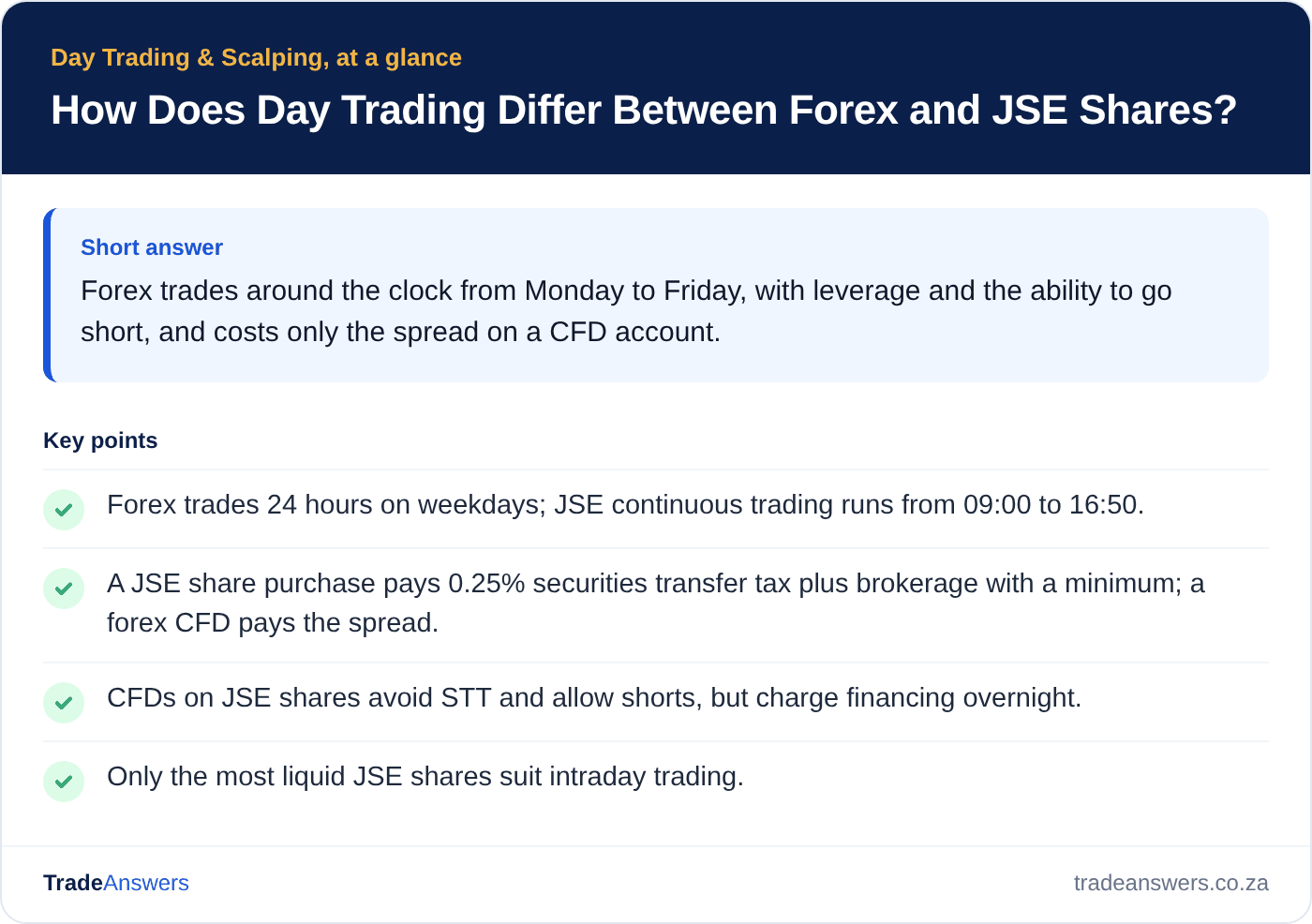
Forex trades around the clock from Monday to Friday, with leverage and the ability to go short, and costs only the spread on a CFD account. JSE shares trade from 09:00 to 16:50 South African time, are usually bought without leverage, and each purchase pays 0.25% securities transfer tax plus brokerage with a minimum charge. For short-term trading those fixed costs put JSE shares at a disadvantage unless positions are large or the shares are traded through CFDs.
📋 ON THIS PAGE
1. The two markets side by side
The main differences for a day trader are hours, costs, leverage and the ability to sell short.
| Forex (CFD account) | JSE shares (share account) | |
|---|---|---|
| Trading hours | 24 hours, Monday to Friday; busiest in the London and New York overlap | Continuous trading 09:00 to 16:50, auctions before and after |
| Costs on a round trip | Spread, sometimes a commission | 0.25% STT on the purchase, brokerage both ways with a minimum, settlement fees, VAT |
| Leverage | Yes, set by the broker | Usually none on a share account |
| Going short | Yes | Not practical for most retail accounts |
| Liquidity | Deep on major pairs and USD/ZAR | Good in the largest shares, thin in many small ones |
| Regulation | FSCA-authorised CFD provider | JSE broker (authorised user) |
Forex session times in South African time are on the forex trading hours page, and JSE auction times on the JSE trading hours page.
2. Costs decide more than the market
A day trade has to earn its costs before it makes anything, and fixed share costs hurt small positions most. Hypothetical example: a R10,000 position opened and closed on the same day, once as a JSE share and once as a forex CFD.
| JSE share | Forex CFD | |
|---|---|---|
| Securities transfer tax | 0.25% on the purchase, R25 | None |
| Brokerage, say 0.1% each way | About R20, more where a minimum applies | None on a spread-only account |
| Spread | Depends on the share | About R10 on a liquid pair |
| Overnight financing | None | None if closed the same day |
The JSE trade starts at least R45 behind on R10,000, and on small trades the broker’s minimum charge makes the gap wider: below about R15,000 per trade the minimum dominates, as set out on the JSE trading cost schedule. The trading cost calculator runs the same comparison on your own figures.
⬇ Download this summary (PNG) · Free to share with the credit “Source: TradeAnswers” (CC BY 4.0).
4. Which JSE shares suit day trading
Only the most actively traded shares have spreads tight enough for trades that last minutes or hours; many smaller shares trade too rarely for a stop to fill where it was placed. The list on the most actively traded JSE shares page is the place to start.
5. The US pattern day trader rule
Neither market here was ever subject to the US pattern day trader rule, which applied only to US margin accounts and is being phased out after the SEC approved its removal in April 2026, as explained in the pattern day trader rule. Profits from either market are taxed the same way, usually as income for an active day trader.
Where this comes from
The JSE’s session times come from its equity market factsheet (JSE, equity market factsheet), and securities transfer tax of 0.25% applies to share purchases (SARS, securities transfer tax).
★ Why It Matters
The choice between forex and JSE shares for day trading is mostly a cost choice. Fixed charges on share purchases take a large share of a small intraday move, which is why most short-term traders in South Africa use CFDs, whatever they trade.
✕ Common mistakes
- Day trading small JSE share positions. Minimum brokerage and 0.25% STT take a large share of a small move.
- Trading thin JSE shares intraday. Wide spreads and few trades mean stops fill badly.
- Holding CFD positions overnight without counting financing. The daily charge adds up on positions held for days.
- Worrying about the US pattern day trader rule. It never applied to South African accounts.
Key Takeaways
- Forex trades 24 hours on weekdays; JSE continuous trading runs from 09:00 to 16:50.
- A JSE share purchase pays 0.25% securities transfer tax plus brokerage with a minimum; a forex CFD pays the spread.
- CFDs on JSE shares avoid STT and allow shorts, but charge financing overnight.
- Only the most liquid JSE shares suit intraday trading.
Frequently asked follow-up questions
Can I day trade JSE shares outside normal JSE hours?
Not the shares themselves: continuous trading runs from 09:00 to 16:50, with auctions before and after. Share CFDs usually follow those hours; some providers quote Top 40 index CFDs for longer, with prices based on their own model outside the exchange session.
Is JSE Top 40 CFD trading the same as day trading actual shares?
No. A Top 40 CFD tracks the index without owning any shares, pays no securities transfer tax, allows short positions and charges financing if held overnight.
Does day trading discipline differ between forex and JSE shares?
The rules are the same: risk a fixed share of the account per trade and stop for the day at a set loss. The difference is cost, which is higher on small JSE share trades.
