i What this calculator does
Quick answer: Add up what you own and subtract what you owe to get a single figure, and see which assets and debts move it most. With the default inputs (cash & savings 80,000, investments & retirement 350,000), it returns net worth of R670,000.00.
This calculator works out your total net worth, subtracting all your liabilities from all your assets, giving you a single figure representing your genuine financial position.
Enter your assets and liabilities, and the calculator returns your total net worth.
This calculator is for educational purposes only. Use current market values for accuracy.
📋 ON THIS PAGE
How to use the Net Worth Calculator
Defaults are supplied throughout, which means the calculator is useful before you have touched it.
- 1. Cash & Savings (R)
- 2. Investments & Retirement (R)
- 3. Property & Vehicles (R)
- 4. Home Loan / Bond Balance (R)
- 5. Other Debt (Car, Credit Card, etc.) (R)
The result panel reports:
- Total Assets Everything you own
- Total Liabilities Everything you owe
- Debt-to-Asset Ratio Liabilities relative to assets
Alongside the headline figures, the calculator reports net worth, total assets, total liabilities, debt-to-asset ratio.
Each operation is listed under the answer, which is what lets you check rather than assume.
A worked example in rand
Hypothetical example. With the default inputs (cash & savings R80,000, investments & retirement R350,000, property &. Vehicles R1,200,000, home loan / bond balance R900,000 and other debt R60,000), the calculator returns a net worth of R670,000.00, positive net worth. It also reports total assets R1,630,000.00, total liabilities R960,000.00 and debt-to-asset ratio 58.9%.
Double the cash & savings to 160,000 and the net worth moves from R670,000.00 to R750,000.00, the total assets moves from R1,630,000.00 to R1,710,000.00 and the debt-to-asset ratio moves from 58.9% to 56.1%. The total liabilities does not change, because it does not depend on that input.
Common results
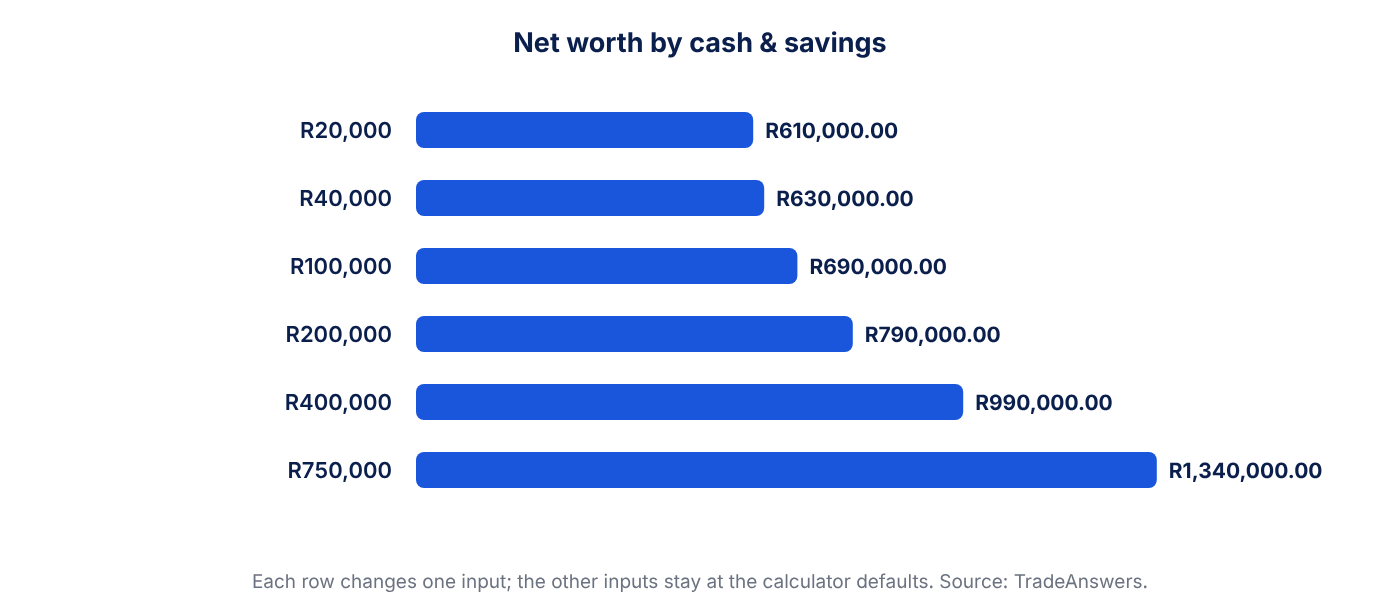
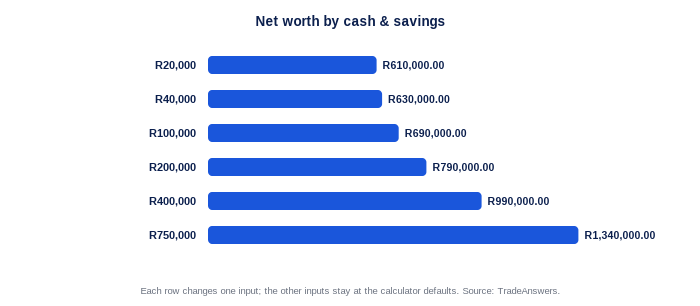
What the calculator returns as the cash &. Savings changes, with every other input at its default (investments & retirement 350,000, property &. Vehicles 1,200,000, home loan / bond balance 900,000, other debt 60,000).
| Cash & Savings | Net Worth | Total Assets | Total Liabilities |
|---|---|---|---|
| R20,000 | R610,000.00 | R1,570,000.00 | R960,000.00 |
| R40,000 | R630,000.00 | R1,590,000.00 | R960,000.00 |
| R100,000 | R690,000.00 | R1,650,000.00 | R960,000.00 |
| R200,000 | R790,000.00 | R1,750,000.00 | R960,000.00 |
| R400,000 | R990,000.00 | R1,950,000.00 | R960,000.00 |
| R750,000 | R1,340,000.00 | R2,300,000.00 | R960,000.00 |
⬇ Download this chart (PNG) · Free to reuse with the credit “Source: TradeAnswers, Net Worth Calculator” (CC BY 4.0).
How the calculation works
The calculator takes five inputs: Cash & Savings, Investments & Retirement, Property & Vehicles, Home Loan / Bond Balance and Other Debt. The net worth is Total Assets − Total Liabilities = R1,630,000.00 − R960,000.00 = R670,000.00. The breakdown also lists cash & savings, investments & retirement, property & vehicles and home loan.
How to read the result
The headline figure is the net worth; the others are there to show where it came from. The two limits that matter are the annual ones: R46,000 (from 1 March 2026) a year into a tax-free savings account and the retirement deduction cap of R430,000 (SARS, tax-free investments).
Contributions above them are either taxed or penalised. The background to this calculation is in Are Paid Trading Courses Worth It?.
Figures used in this calculator
The South African constants this calculator relies on, with the page that holds the current value and the date it was last verified.
- TFSA limits: R46,000 (from 1 March 2026) a year, R500,000 lifetime, 40% penalty on excess. Source: Tax-Free Savings Account Limits (verified 27 September 2026).
- Retirement deduction cap: 27.5% of income, R430,000 (from 1 March 2026) a year. Source: Retirement Fund Contribution Limits (verified 27 September 2026).
- Two-pot savings withdrawal: Once a tax year, minimum R2,000, taxed at marginal rate. Source: Two-Pot Retirement System 2026: Rules, Limits and Tax (verified 27 September 2026).
- Retirement lump sum tax-free portion: R550,000 (2026/27 tables). Source: Retirement Lump Sum Tax Tables (verified 13 October 2026).
The South African angle
The tax-free savings account limits are R46,000 a year and R500,000 over a lifetime, and the penalty for exceeding the annual limit is 40% of the excess, which the calculators here apply.
What moves the result most
With every other input at its default, Net Worth (R670,000.00) is most sensitive to Property & Vehicles (R): changing it from 1,200,000 to 1,320,000 moves the result to R790,000.00, +17.9%. The table tests each input on its own, so it shows where a small error in an input matters most.
| Input | Changed from | Changed to | Net Worth | Effect |
|---|---|---|---|---|
| Property & Vehicles (R) | 1,200,000 | 1,320,000 (+10%) | R790,000.00 | +17.9% |
| Home Loan / Bond Balance (R) | 900,000 | 990,000 (+10%) | R580,000.00 | −13.4% |
| Investments & Retirement (R) | 350,000 | 385,000 (+10%) | R705,000.00 | +5.2% |
| Cash & Savings (R) | 80,000 | 88,000 (+10%) | R678,000.00 | +1.2% |
| Other Debt (Car, Credit Card, etc.) (R) | 60,000 | 66,000 (+10%) | R664,000.00 | −0.9% |
Assumptions and limitations
It uses the values you enter for assets and debts. Property, shares and retirement funds change in value, and some assets cannot be sold quickly or without tax.
Key Takeaways
- Defaults are supplied throughout, which means the calculator is useful before you have touched it.
- The headline figure is the net worth; the others are there to show where it came from.
- With every other input at its default, Net Worth (R670,000.00) is most sensitive to Property & Vehicles (R): changing it from 1,200,000 to 1,320,000 moves the result to R790,000.00, +17.9%.
- It uses the values you enter for assets and debts.
Spotted an outdated figure? If a rate, limit or formula in this calculator no longer matches its source, email us the page and the source. A material correction is dated on the Updates Log.
Frequently asked questions
What should I actually count as an asset?
Include liquid or valuable items, cash, investment accounts, retirement funds, property (at current market value, not purchase price), and vehicles, avoid overestimating depreciating personal items like furniture or clothing, which typically have minimal genuine resale value.
Should I include my primary residence in net worth calculations?
Most net worth calculations do include your home at current market value, though some prefer excluding it since it's not typically liquidated for spending, the right approach depends on what you're using the figure for, include it for a complete wealth picture.
Is a negative net worth a problem?
A negative net worth (more liabilities than assets) is common, especially early in adulthood or after taking on debt like a home loan, it becomes more concerning if it's persistent or growing rather than improving over time as you pay down debt and build assets.
How often should I recalculate my net worth?
Many people find checking quarterly or annually gives a meaningful sense of progress without becoming an unhealthy obsession over short-term market fluctuations affecting investment account values.
Does net worth include my trading account balance?
Yes, your trading account balance is a genuine asset and should be included, along with any other investment or brokerage accounts, at their current market value.
Want to embed this calculator on your site?
Embed this calculator
Free to use on your own site. Copy the code below and paste it where you want the calculator to appear.
<iframe src="https://www.tradeanswers.co.za/embed/net-worth-calculator.html"
        width="100%" height="690" style="border:0;max-width:520px"
        title="Net Worth Calculator - TradeAnswers" loading="lazy"></iframe>
<p><a href="https://www.tradeanswers.co.za/net-worth-calculator.html">Net Worth Calculator</a> by <a href="https://www.tradeanswers.co.za/">TradeAnswers</a></p>