i What this calculator does
Quick answer: This calculator works out the percentage gain or loss between any two values, whether for a trade, an investment, or any other financial. With the default inputs (starting value 100, ending value 135), it returns percentage gain of 35.00%.
This calculator works out the percentage gain or loss between any two values, whether for a trade, an investment, or any other financial comparison.
Enter your starting and ending values, and the calculator returns the percentage change and absolute difference.
This calculator is for educational purposes only. Not financial advice.
📋 ON THIS PAGE
How to use the Percentage Gain/Loss Calculator
Every field starts with a sensible default, so a result appears before you change anything at all.
- 1. Starting Value
- 2. Ending Value
The result panel reports:
- Starting Value
- Ending Value
Alongside the headline figures, the calculator reports starting value, ending value, percentage change, absolute difference.
The method is visible: the steps sit directly below the result.
How to read the result
Start with the percentage gain, which is the number the trade decision turns on, then check the supporting figures. Sanity-check any growth plan by annualising the monthly return: 3% a month is 43% a year, 5% a month is 80% a year, and neither is a planning assumption. For the reasoning, read What Is a Stop-Loss and Take-Profit Order?.
A worked example in rand
Hypothetical example. Take the defaults as a worked case: starting value 100 and ending value 135. The result is a percentage gain of 35.00%, value increased. Alongside it: absolute difference 35.00, starting value 100.00 and ending value 135.00.
Change one input, the starting value, to 200, and the result turns from a 35.00% gain into a 32.50% loss, the absolute difference moves from 35.00 to 65.00 and the starting value moves from 100.00 to 200.00. The ending value does not change, because it does not depend on that input.
Common results
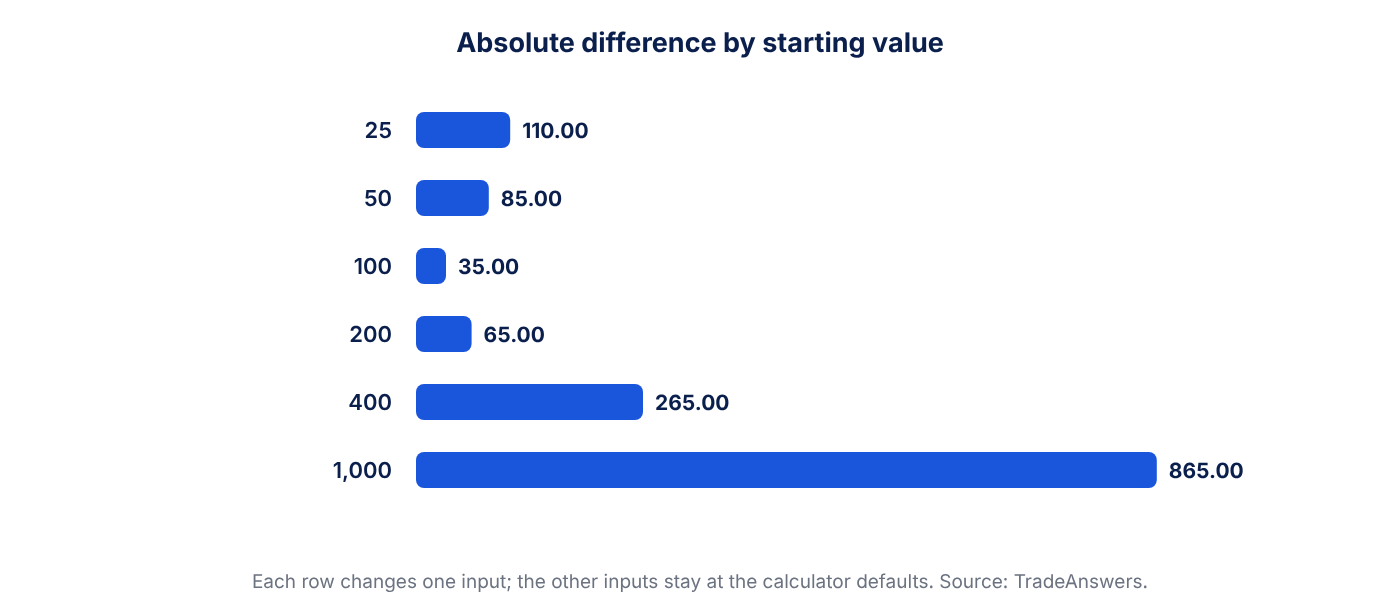
What the calculator returns as the starting value changes, with every other input at its default (ending value 135).
| Starting value | Percentage change | Absolute difference |
|---|---|---|
| 25 | +440.00% | 110.00 |
| 50 | +170.00% | 85.00 |
| 100 | +35.00% | 35.00 |
| 200 | −32.50% | 65.00 |
| 400 | −66.25% | 265.00 |
| 1,000 | −86.50% | 865.00 |
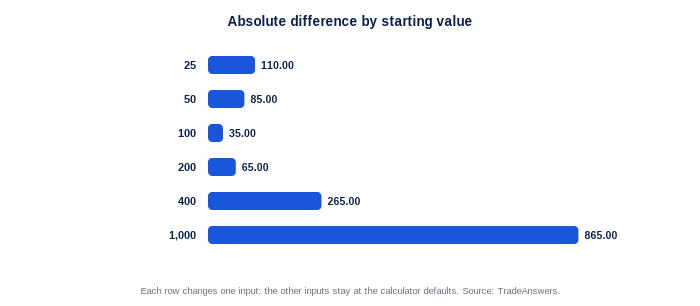
⬇ Download this chart (PNG) · Free to reuse with the credit “Source: TradeAnswers, Percentage Gain/Loss Calculator” (CC BY 4.0).
How the calculation works
There are two inputs to fill in: Starting Value and Ending Value. The percentage change is (Ending − Starting) ÷ Starting × 100 = (135.00−100.00)÷100.00×100 = 35.00%. The breakdown also lists starting value, ending value, absolute difference and percentage change.
The South African angle
The gap between a part-time trader's hours and a full-time income is usually measured in years of compounding, not months. The calculators here put a number on that gap rather than an aspiration. South African inflation has averaged roughly 5% a year over the past decade, so a plan that grows an account by 5% a year in rand is standing still in real terms.
Trading profit from frequent trading is taxed by SARS as income at your marginal rate, up to 45%, so a growth target has to be set on the after-tax figure, not the account statement.
Figures used in this calculator
The South African constants this calculator relies on, with the page that holds the current value and the date it was last verified.
- Income tax on frequent trading profit: Marginal rate, 18% to 45%. Source: SARS Income Tax Tables (verified 27 September 2026).
- CGT on investment gains: 40% inclusion after R50,000 (2026/27 tax year) exclusion. Source: Capital Gains Tax Rates and Exclusions (verified 15 October 2026).
What moves the result most
With every other input at its default, Percentage Gain (35.00%) is most sensitive to Ending Value: changing it from 135 to 148.5 moves the result to 48.50%, +38.6%. The table tests each input on its own, so it shows where a small error in an input matters most.
| Input | Changed from | Changed to | Percentage Gain | Effect |
|---|---|---|---|---|
| Ending Value | 135 | 148.5 (+10%) | 48.50% | +38.6% |
| Starting Value | 100 | 110 (+10%) | 22.73% | −35.1% |
Assumptions and limitations
It calculates the percentage change between the two values you enter, before costs, dividends and tax. A loss needs a larger percentage gain to recover, which the recovery figure shows.
Key Takeaways
- Every field starts with a sensible default, so a result appears before you change anything at all.
- Start with the percentage gain, which is the number the trade decision turns on, then check the supporting figures.
- With every other input at its default, Percentage Gain (35.00%) is most sensitive to Ending Value: changing it from 135 to 148.5 moves the result to 48.50%, +38.6%.
- It calculates the percentage change between the two values you enter, before costs, dividends and tax.
Spotted an outdated figure? If a rate, limit or formula in this calculator no longer matches its source, email us the page and the source. A material correction is dated on the Updates Log.
Frequently asked questions
What's the difference between percentage gain and percentage points?
Percentage gain measures relative change from the original value, going from R100 to R150 is a 50% gain, percentage points measure absolute difference between two percentages, the distinction matters and is a common source of confusion, especially in financial reporting.
Does this calculator work for both gains and losses?
Yes, if your ending value is higher than your starting value, the result shows as a positive percentage gain, if lower, it shows as a negative percentage loss, the same formula handles both directions automatically.
Why does a 50% loss require more than a 50% gain to recover?
Because percentage changes are relative to a shifting base, losing 50% of R100 leaves R50, but gaining back to R100 from R50 requires a 100% gain, not 50%, this asymmetry is a fundamental, often underappreciated aspect of percentage-based returns.
Can I use this for currency values, not just Rand?
Yes, the calculation is currency-agnostic, simply enter your starting and ending values in whatever currency or units you're working with, the percentage result will be accurate regardless of the specific currency involved.
Is this the same calculation used for investment returns generally?
Yes, this is the standard percentage return formula used broadly across finance, for annualised returns over multiple years accounting for compounding, use our dedicated CAGR Calculator instead.
Want to embed this calculator on your site?
Embed this calculator
Free to use on your own site. Copy the code below and paste it where you want the calculator to appear.
<iframe src="https://www.tradeanswers.co.za/embed/percentage-gain-loss-calculator.html"
        width="100%" height="510" style="border:0;max-width:520px"
        title="Percentage Gain/Loss Trading Calculator - TradeAnswers" loading="lazy"></iframe>
<p><a href="https://www.tradeanswers.co.za/percentage-gain-loss-calculator.html">Percentage Gain/Loss Calculator</a> by <a href="https://www.tradeanswers.co.za/">TradeAnswers</a></p>