i What this calculator does
Quick answer: Calculate the exact stop-loss price for any trade based on your entry price, risk percentage, and account size. With the default inputs (account size 50,000, risk per trade 2), it returns stop-loss price of 98.0000.
This calculator works out the exact stop-loss price for your trade, based on your entry price, how much you're willing to risk (in Rand or as a percentage of your account), and your position size.
Enter your account size, risk percentage, entry price, position size and direction, and the calculator returns the stop-loss price that keeps the loss within your risk, with the rand risk and the stop distance.
This calculator is for educational purposes only and doesn't account for spread or slippage. Not financial advice.
📋 ON THIS PAGE
How to use the Stop-Loss Calculator
The inputs carry workable values from the start. Nothing has to be entered to get a number on screen.
- 1. Account Size (R)
- 2. Risk Per Trade (%)
- 3. Entry Price
- 4. Position Size (units)
- 5. Direction
The result panel reports:
- Stop-Loss Price
- Risk Amount
- Stop Distance
- Position Size
Alongside the headline figures, the calculator reports stop-loss price, risk amount, stop distance, position size.
You can see how the number was built: each step appears beneath the answer.
How to read the result
Start with the stop-loss price, which is the number the trade decision turns on, then check the supporting figures. Check the stop and the target against the instrument's average daily range: a stop inside it will be hit by noise, a target several ranges away will rarely be reached. For the reasoning, read What Is a Stop-Loss and Take-Profit Order?.
A stop price is not a guaranteed exit price
A standard stop order becomes a market order when the price reaches the stop, so it fills at the next available price. In a fast market or over a weekend that can be well past the stop. Worked example (hypothetical, defaults): 500 units bought at 100 with the stop at 98 risk R1,000. If the market opens at 96.50 after news, the stop fills there and the loss is 500 × 3.50 = R1,750.
A stop-limit order sets a worst acceptable price, but if the market gaps past it the order does not fill at all and the position stays open. Some brokers offer guaranteed stops for a fee, which fill exactly at the stop. Spreads also widen around news and at the daily rollover, which can trigger a stop on a sell order even when the quoted mid price never reached it.
A worked example in rand
Hypothetical example. Take the defaults as a worked case: account size R50,000, risk per trade 2%, entry price 100, position size 500 units and direction Buy (Long). The result is a stop-loss price of 98.0000, below your entry. Alongside it: risk amount R1,000.00, stop distance 2.0000 and position size 500 units.
Change one input, the account size, to 100,000, and the stop-loss price moves from 98.0000 to 96.0000, the risk amount moves from R1,000.00 to R2,000.00 and the stop distance moves from 2.0000 to 4.0000. Note that the position size stays the same; it is set by the other inputs.
Common results
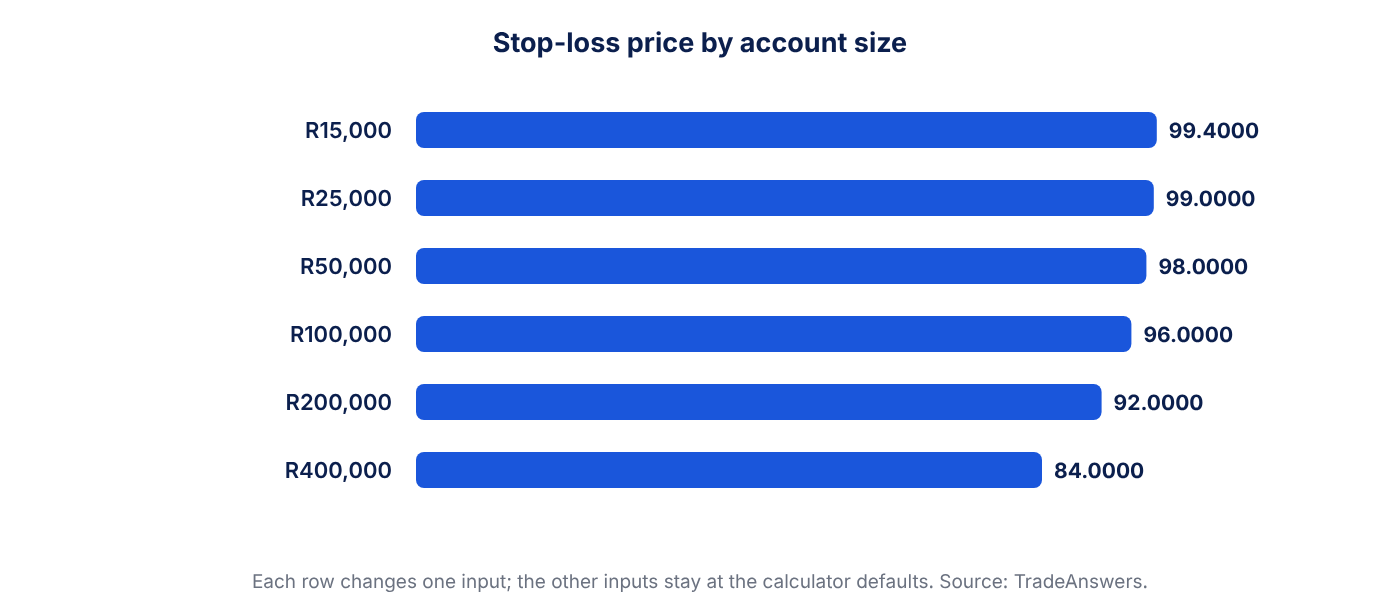
What the calculator returns as the account size changes, with every other input at its default (risk per trade 2, entry price 100, position size 500, direction Buy (Long)).
| Account Size | Stop-Loss Price | Risk Amount | Stop Distance |
|---|---|---|---|
| R15,000 | 99.4000 | R300.00 | 0.6000 |
| R25,000 | 99.0000 | R500.00 | 1.0000 |
| R50,000 | 98.0000 | R1,000.00 | 2.0000 |
| R100,000 | 96.0000 | R2,000.00 | 4.0000 |
| R200,000 | 92.0000 | R4,000.00 | 8.0000 |
| R400,000 | 84.0000 | R8,000.00 | 16.0000 |
⬇ Download this chart (PNG) · Free to reuse with the credit “Source: TradeAnswers, Stop-Loss Calculator” (CC BY 4.0).
How the calculation works
There are five inputs to fill in: Account Size, Risk Per Trade, Entry Price, Position Size and Direction. The risk amount is Account × Risk% = R50,000.00 × 2.0% = R1,000.00. The stop distance is Risk Amount ÷ Units = R1,000.00 ÷ 500 = 2.0000.
The stop-loss price is Entry − Stop Distance = 98.0000. The breakdown also lists account size, risk per trade, risk amount and entry price. How stop orders work is explained in CME Group’s course on order types (CME Group, order types and execution).
The South African angle
The JSE closes at 17:00 SAST and most rand pairs are quietest between the New York close and the Tokyo open, so a stop or target placed in those hours is managed by the thin liquidity of the Asian session.
Rand pairs are quoted to four decimals and gold to two, while JSE shares are quoted in cents, so the "price move". A calculator reports is in the instrument's own unit and has to be read that way.
Figures used in this calculator
The South African constants this calculator relies on, with the page that holds the current value and the date it was last verified.
- JSE close: 17:00 SAST. Source: JSE Trading Hours and Holidays (verified 27 September 2026).
- Forex session liquidity: London and New York, about 10:00 to 23:00 SAST. Source: Global Market Hours and Holidays (verified 27 September 2026).
Assumptions and limitations
It assumes the stop is filled at the level calculated. In fast markets or over weekends a stop can be filled worse, and a stop placed too close to normal price noise is often hit before the trade has room to work.
Key Takeaways
- The inputs carry workable values from the start.
- Start with the stop-loss price, which is the number the trade decision turns on, then check the supporting figures.
- It assumes the stop is filled at the level calculated.
- There are five inputs to fill in: Account Size, Risk Per Trade, Entry Price, Position Size and Direction.
Spotted an outdated figure? If a rate, limit or formula in this calculator no longer matches its source, email us the page and the source. A material correction is dated on the Updates Log.
Frequently asked questions
How is this different from the ATR Stop-Loss Calculator?
This calculator sets your stop-loss based on a simple, fixed percentage or Rand risk amount, regardless of current market volatility. The ATR Stop-Loss Calculator instead adapts the distance to current volatility, generally considered more sound across varying market conditions.
What risk percentage should I actually use per trade?
1-2% of account balance per trade is a widely cited range in trading education, though the right figure depends on your overall risk tolerance and how many trades you typically take, higher percentages increase both potential growth and risk of ruin.
Does this calculator also tell me my position size?
Yes, once you enter your risk amount and stop distance, the calculator returns both your exact stop-loss price and the resulting position size needed to keep your risk at your specified amount.
Should my stop-loss always be based on a fixed percentage?
Not necessarily, many experienced traders instead place stops based on genuine technical levels like support and resistance, then check what percentage of the entry price that distance represents, rather than forcing a fixed percentage onto every trade.
Does this work for short (sell) positions too?
Yes, select your direction, for a long position the stop-loss sits below your entry, for a short position it sits above your entry, and the calculator adjusts the formula accordingly.
Want to embed this calculator on your site?
Embed this calculator
Free to use on your own site. Copy the code below and paste it where you want the calculator to appear.
<iframe src="https://www.tradeanswers.co.za/embed/stop-loss-calculator.html"
        width="100%" height="690" style="border:0;max-width:520px"
        title="Stop-Loss Calculator - TradeAnswers" loading="lazy"></iframe>
<p><a href="https://www.tradeanswers.co.za/stop-loss-calculator.html">Stop-Loss Calculator</a> by <a href="https://www.tradeanswers.co.za/">TradeAnswers</a></p>